A short, repeated melodic or rhythmic figure, usually played by an instrument, that anchors a song. Rock riffs are often guitar figures; in electronic music the same role falls to a synth or bass line.
The African-American music born in the Deep South around the start of the 20th century, built on call and response, bent "blue" notes and short repeating forms such as the twelve-bar blues. Almost every later popular style, from rock and soul to house, carries some of its scales and phrasing.
The music that followed punk from the late 1970s: still tense and stripped-down, but more experimental, with prominent bass, angular guitars, cold synthesizers and detached vocals. Its dark branches, gothic rock and darkwave, have been revived again and again since.
The short, memorable idea a song is built to stick with you: a sung phrase, a riff, a synth line. A hook is designed for repetition and usually arrives early.
A pattern repeated persistently, often for a whole section, while other parts change above it. Minimal techno and much film music build tension from ostinatos.
Playing the guitar by plucking the strings with the fingertips or nails instead of strumming with a pick. One player can then carry a bass line, chords and melody at once, and tapping or slapping the strings and body can add percussion.
A hushed, smoky vocal floats over plucked folk guitar and a slow electronic pulse, turning a simple declaration of devotion into a late-night confession.
Marcus Marr and Chet Faker (Nick Murphy) recorded this disco-funk jam in four days in a Brixton studio in July 2015: a funk-flecked guitar riff and a soulful plea about a relationship going wrong, made into a reason to dance.
Robin Schulz lifts a mournful 2010 French folk-pop song onto a bouncing deep house beat, Nili Hadida's bleak prayer and a looping guitar riff becoming a number one across Europe in 2014.
Nile Rodgers' chicken-scratch guitar, Pharrell's easy vocal and Daft Punk's robot choir turn a four-chord loop into the most irresistible disco revival of the 2010s: the lead single of Random Access Memories, in its radio edit.
Nile Rodgers tells his own story in the third of Daft Punk's Collaborators films, a warm, funny portrait of the guitarist whose rhythm runs through Random Access Memories.
Arctic Monkeys turn a jealous late-night text into a riff-heavy stomp, with Alex Turner's rapid-fire wordplay riding a fuzzed-out, swaggering guitar line.
A heavy, crawling riff, stomping handclaps and a late-night text that should never have been sent: Do I Wanna Know? turns romantic doubt into slow-burning swagger.
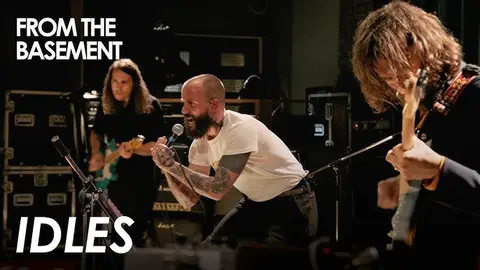
IDLES' song about the cycle of alcoholism passed from mother to son, from their 2021 album Crawler: a menacing one-note riff, heavy chords and Joe Talbot howling a gospel-preacher call, here in a live KEXP session.
'Crystalised', The xx's 2009 debut single, is minimal indie pop at its most intimate: a muted guitar riff, a sparse beat by Jamie xx, and two voices, Romy Madley Croft's and Oliver Sim's, answering each other verse by verse.
The lead single of Freeland's Cope swaps the guitar riff for a roaring synth and puts Kurt Baumann's deadpan vocal over breakbeat-bred drums: electronic rock with a raw, defiant edge.
'Biggest & The Best' is the lead single from Clawfinger's 1997 self-titled album: Swedish-Norwegian rap metal with industrial programming, aimed squarely at people who think they are almighty.
A pulsating electro track from Vitalic's 2001 Poney EP on International DeeJay Gigolo: driving machine beats and a snarling synth riff that capture the raw energy of the early-2000s dance floor.
Dead Kennedys' 1981 single sets Jello Biafra's satire of a moronic party over East Bay Ray's breakneck surf-punk riff, and became the first UK top-40 hit with the word in its title, despite a BBC ban.