Review
Genre and Mood
Daft Punk built Harder, Better, Faster, Stronger out of a funk sample and a list of verbs, and it became a cornerstone of French house. Electronic precision meets a funk swagger in a mood that is energetic, futuristic and, by now, simply iconic.
Song Summary
The lyric is a mantra of self-improvement recited by a vocoded voice: work it, make it, do it, makes us harder, better, faster, stronger. The groove is built on a keyboard riff sampled from Edwin Birdsong’s 1979 track “Cola Bottle Baby”, looped and filtered until it feels like a machine with soul, in F sharp minor. The genius is in the arrangement of the words: the same phrases are cut up, reordered and stacked until they become rhythm themselves.
Musical Breakdown
Intro
The sampled riff arrives first, a strutting, slightly dirty funk figure that sets the tempo and the attitude.
Verse 1
The robot voice begins listing commands, each word landing on the beat like a step in an assembly line. It is simple and instantly memorable.
Build-up
The vocal phrases start to overlap and the sample opens up, adding bite and brightness as the energy rises.
Main Section
The words are chopped and recombined faster and faster, pairs of phrases interleaving until the line becomes a puzzle you can sing.
Climax
Everything stacks into a dense wall of vocoder and groove, the mantra repeated with full force like a factory at peak production. It is euphoric in a strangely disciplined way, a rush that never loses its grid.
Outro
The layers strip back to the core loop and the track winds down with the same mechanical confidence it started with.
Concepts in Focus
The track is a textbook case of sampling. Daft Punk took a keyboard riff from Edwin Birdsong’s Cola Bottle Baby and made it the foundation of a new song, and Birdsong is credited as a co-writer for it. The chain did not stop there: Kanye West’s 2007 hit Stronger is built on this track, so one riff from 1979 runs through two famous records a generation apart.
The voice is a vocoder. A vocoder imposes the shape of speech onto a synthesized tone, so the words are intelligible but the timbre is a machine’s. On a song whose lyric is a list of instructions for working harder, that robotic voice is the message as much as the words.
The whole arrangement is a study in the loop. The sample repeats almost unchanged; what moves is the order of the words on top of it. Compare the cover by Pomplamoose – Harder, Better, Faster, Stronger, which plays the same idea by hand and shows how much of the song lives in that rearrangement.
Artistic Context
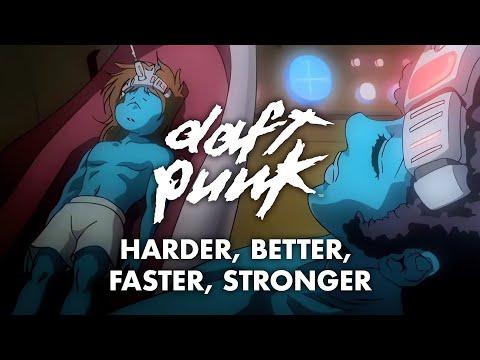
The track appeared on Discovery, Daft Punk’s second album, made by Thomas Bangalter and Guy-Manuel de Homem-Christo and released on Virgin in 2001; it was issued as the album’s fourth single on 13 October 2001. Its animated video was directed by Kazuhisa Takenouchi of Toei Animation under the supervision of Leiji Matsumoto, and it became a scene of Interstella 5555, the film that set the whole album to pictures. The record pushed their sound toward pop, disco and robotic vocals, and this track is its most compact statement: a found sample, a handful of words and an obsessive sense of arrangement.
Impact and Reception
On release it reached number 25 in the UK, number 17 in France and number 3 on the US Dance Club Songs chart, and it is now certified platinum in the UK. It grew bigger with every year. Kanye West built his 2007 hit “Stronger” around it, and Daft Punk joined him on stage at the 2008 Grammy Awards; the live version from Alive 2007 then won the Grammy for Best Dance Recording itself. NME placed it at number 132 among the best tracks of 1996 to 2011, and Billboard ranked it second among Daft Punk’s greatest songs in 2021. It earns its place here as pure design. Work it, make it, do it: press play.