Review

“I Need a Dollar” by Aloe Blacc is a plea about hard times written like an old work song and recorded like a 1960s soul single. On stage the chorus belongs to the audience as much as to the singer, and the story of a job lost and a dollar borrowed becomes something a room can share.
The studio single

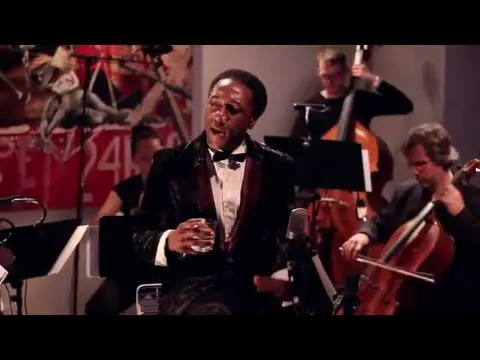
The single had two official videos: the first, filmed in New York, runs on a split screen, Blacc singing in an apartment on one side while a man walks the streets on the other; the second, directed by Derek Pike in 2011, follows him along a Nevada highway to a Las Vegas casino. The performance embedded at the top of this page is different again: a live set filmed for Highsnobiety TV in 2011 at MADE, a creative space in Berlin, on an evening that also featured the violinist and composer Mihalj “Miki” Kekenj and the painter Jaybo.
Live in the studio

Stones Throw, his label, also filmed the song played live in the studio, the closest thing to hearing the arrangement as the musicians built it.
Genre and Mood
“I Need a Dollar” is soul in the strict, historical sense: a live band, a gospel-tinged melody and a story told in plain words, released in 2010 as part of the retro-soul revival centred on a few Brooklyn studios. The R&B and alternative tags come from its route to the public, through an indie label and an HBO title sequence rather than radio. The mood is reflective in the verses and uplifting in the chorus, and the gap between the two is what the song is about.
About the Artist
Aloe Blacc is the stage name of Egbert Nathaniel Dawkins III, born in 1979 in Orange County, California, to Panamanian parents. He started as a rapper in the duo Emanon with the producer Exile, signed to Stones Throw Records in 2006 for his first album Shine Through, and turned increasingly to songwriting and singing. Good Things (2010) made him a star in Europe; three years later his voice carried Avicii’s “Wake Me Up” around the world.
Song Summary
Blacc wrote the chorus while driving in Los Angeles in 2005, recorded it as a phone demo and kept it. In February 2009 his label sent him to New York to work with the production team Truth & Soul, Leon Michels and Jeff “Jeff Dynamite” Silverman, at Soul Fire Studios; the band started jamming, and the chord progression they found fitted the lyric he already had. He told Complex he heard it as something like a spiritual, and that field recordings of chain gangs shaped its feel. The verses tell a simple story: a boss lets the narrator go, the last paycheck is spent, whiskey and wine are the only company, and the chorus asks whoever is listening to share a dollar.
Sound Breakdown
Intro: Smooth and Soulful
The band sets up the groove before the voice arrives, unhurried and warm, with the piano at its centre.
First Verse: The Struggle Begins
Blacc sings the verse almost conversationally, laying out the story of the job and the boss. The plainness is deliberate: it is the delivery of a work song, where the words carry the weight and the voice does not decorate them.
Chorus: A Universal Cry
The title phrase arrives with short answering interjections between the lines. It is a hook built from repetition rather than from melodic leaps, which is why it travels so easily from a television title sequence to a singing crowd.
Bridge: Quiet Reflection
The questions about tomorrow, borrowing and the bottle form a darker interlude. The song pauses its plea and lets the narrator wonder where comfort might come from, before the chorus returns.
Final Chorus: A Powerful Conclusion
The last choruses turn the request outward with repeated calls to share a dollar. On stage this is the part an audience is invited to join, and a private complaint becomes a collective one.
Concepts in Focus
The song is a lesson in the hook. The chorus is one sentence repeated with tiny variations, and its pull comes from that repetition and from the space left between lines for the answering interjections. A good hook is not always a clever one; here it is a phrase anybody could say, set where the music makes it impossible to forget.
It also shows how a chord progression and a lyric can meet by accident. Blacc had the words for years; the progression came out of a jam by Truth & Soul’s musicians, and he recognised that the song in his head fitted it. Listen to the band under the voice: the progression is what the musicians were playing before the lyric met it, and the song keeps the loose feel of that jam.
Finally, this page is built around a live recording rather than the studio master. Compare it with the Stones Throw studio session above: a live performance trades the control of the studio for the room, and a chorus this simple is the part a room can take over. Blacc’s voice later travelled even further in other people’s productions; on Roseaux – Walking on the Moon he sings a Police song over French electronic arrangements.
Overall Vibe
“I Need a Dollar” is soulful in its sound, reflective in its story and uplifting in its chorus. The song asks for help without self-pity, and in a live setting that request is answered, at least in song, by everyone in the room.
Conclusion
Released as the first single from Good Things on 16 March 2010, the song became the theme of HBO’s How to Make It in America after the show’s original choice was dropped, and then a European hit: number 1 in Flanders, number 2 in the UK and Ireland, and platinum or better in several countries. Its instrumental became a favourite for hip-hop freestyles, Xavier Rudd covered it on Triple J’s Like a Version, and Blacc performed it on Later… with Jools Holland, Conan and other shows. Put on the live version, then the studio session, and listen to how the same chorus works in each.