Review
Genre and Mood
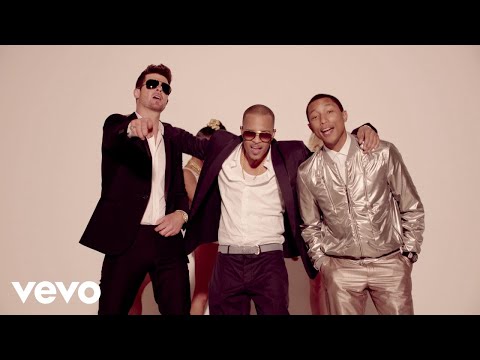
Robin Thicke, T.I. and Pharrell Williams put together Blurred Lines, a pop and R&B single dressed in vintage funk. Its groove is playful and loose, built to make bodies move, but the lyric is provocative in ways that have only grown more contentious over time. It is one of the defining summer songs of the 2010s and one of its most argued-about.
Song Summary
On the surface the song is a flirtatious party track: Thicke’s falsetto teasing someone on the dancefloor, Pharrell’s background whoops and T.I.’s guest verse adding swagger. Musically it is built from very few parts: bass guitar, keyboards, a dry drum pattern and the syncopated cowbell that never stops. Thicke and Williams wrote and recorded it in July 2012 in about 90 minutes. The memorable detail is that minimalism: Pharrell’s production leaves almost everything out, so the falsetto and the cowbell carry the whole song.
Musical Breakdown
The track is a loop rather than a journey, keeping its groove constant while voices take turns on top.
Intro
A cowbell, a playful shout and the dry, swinging beat set the tone immediately, with Pharrell’s background vocals adding a party atmosphere.
Verse 1
Thicke sings in a smooth, confident register, the bass bouncing underneath him while the percussion keeps clacking.
Chorus
The hook arrives in high falsetto, the catchiest moment of the song and the line everyone remembers.
Bridge
T.I. takes over with a quick-fire rap verse, shifting the energy without changing the groove.
Outro
The beat strips back to its percussion and vocal ad-libs before fading, as if the party is carrying on without you.
Concepts in Focus
The song’s signature is syncopation. Pharrell’s drum part uses syncopated cowbell patterns, accents placed between the main beats, so the rhythm seems to lean and skip instead of marching. Clap along with the cowbell rather than the kick and you will find yourself off the beat almost at once.
Together with the bass and keyboards, that pattern makes a groove, the felt way the parts lock together. The groove is also what the courts argued about. Marvin Gaye’s family claimed that Blurred Lines copied the feel of his 1977 “Got to Give It Up”, and in March 2015 a jury agreed, finding infringement in elements such as the hooks, bass lines and keyboard chords; the Ninth Circuit upheld the verdict 2 to 1 in 2018. Because the dissenting judge saw no shared melody, harmony or rhythm, the case became a debate about whether a style and a groove can be owned, and commentators warned of a chilling effect on songwriters. Compare how another hit handled resemblance through credits in Ed Sheeran – Shape of You.
T.I.’s verse shows the role of the <a href=“https://korczis.github.io/sonic-playground/concept/featured-artist/” class=“concept-link font-medium text-primary-700 underline decoration-dotted underline-offset-4 hover:decoration-solid dark:text-primary-400” data-concept=“featured-artist” title=“A guest performer credited on another artist’s track, usually as “feat.”: a rapper’s verse, a singer’s hook or a second voice. Features bring together different styles and audiences and are central to hip-hop, R&B and dance music.“>featured artist. He recorded it several months after Thicke and Williams finished the song; it brings a rapper’s audience and a contrasting voice, and it gives a loop-based song the change of texture it needs in its second half.
Artistic Context
Blurred Lines was released on 26 March 2013 as the lead single and title track of Robin Thicke’s album, on Pharrell’s Star Trak label with Interscope, with Pharrell producing alone and co-writing. Its sound draws heavily on 1970s funk and disco. After the 2015 verdict, which found Thicke and Williams (but not T.I.) liable and awarded the Gaye family more than $7 million, reduced by the court to $5.3 million plus a share of future royalties, Marvin Gaye was added to the songwriting credits.
Impact and Reception
The single spent 12 consecutive weeks at number one on the Billboard Hot 100, the longest run of 2013, and was the UK’s best-selling single of the year with nearly 1.5 million copies; it was nominated for Record of the Year at the Grammys and is certified diamond in the US. Its video, directed by Diane Martel, was widely condemned as sexist, and the lyric was criticised for its attitude to consent, to the point that several UK universities banned it from student events. It is on this playground as an honest snapshot of a pop moment: irresistible as production, uncomfortable as text. Listen with both reactions in mind.