Prismatic × Sig Nihl // Human Systems Diagnostics Artistic

Catharsisas a Service™

Emotional State Transition Endpoint

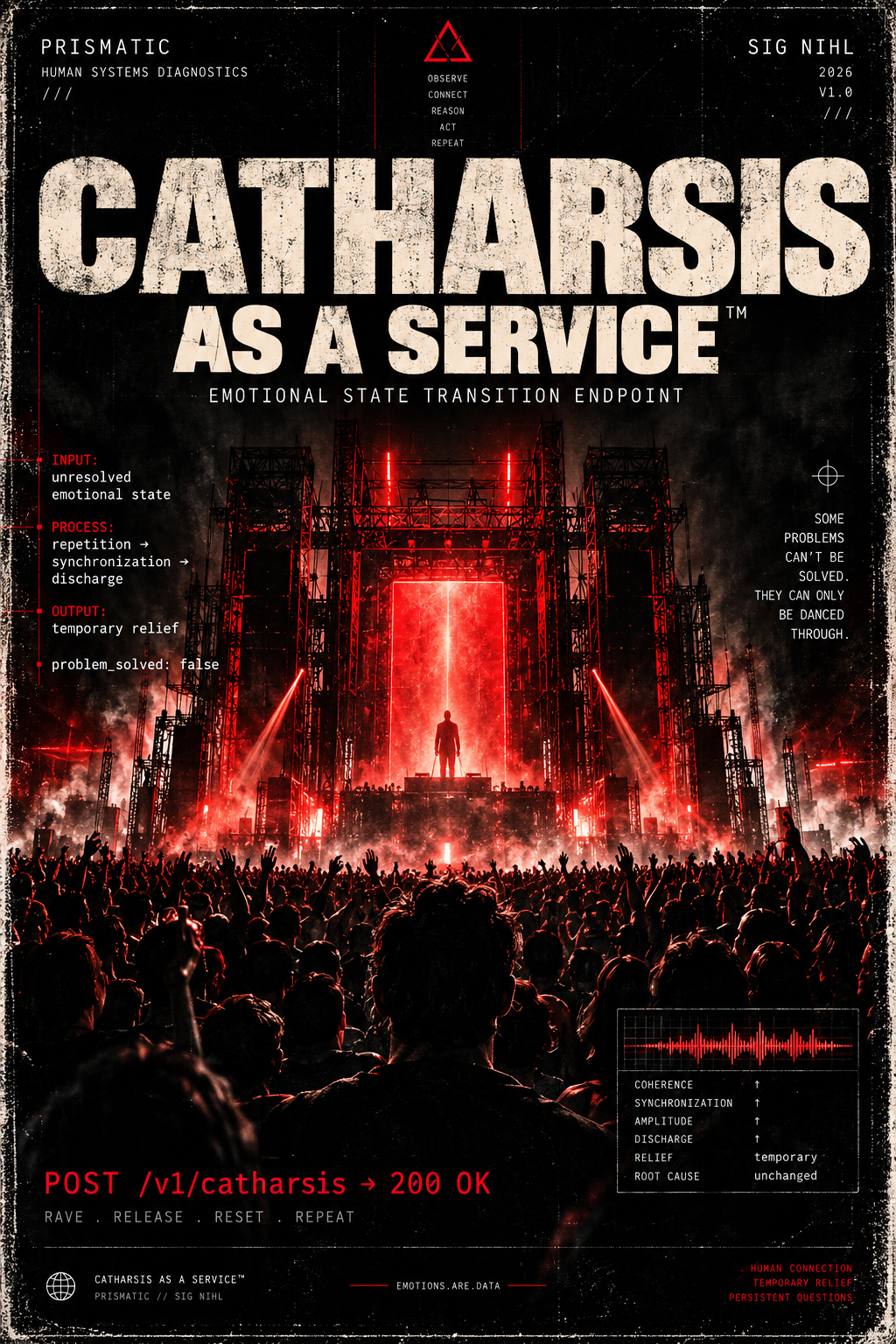
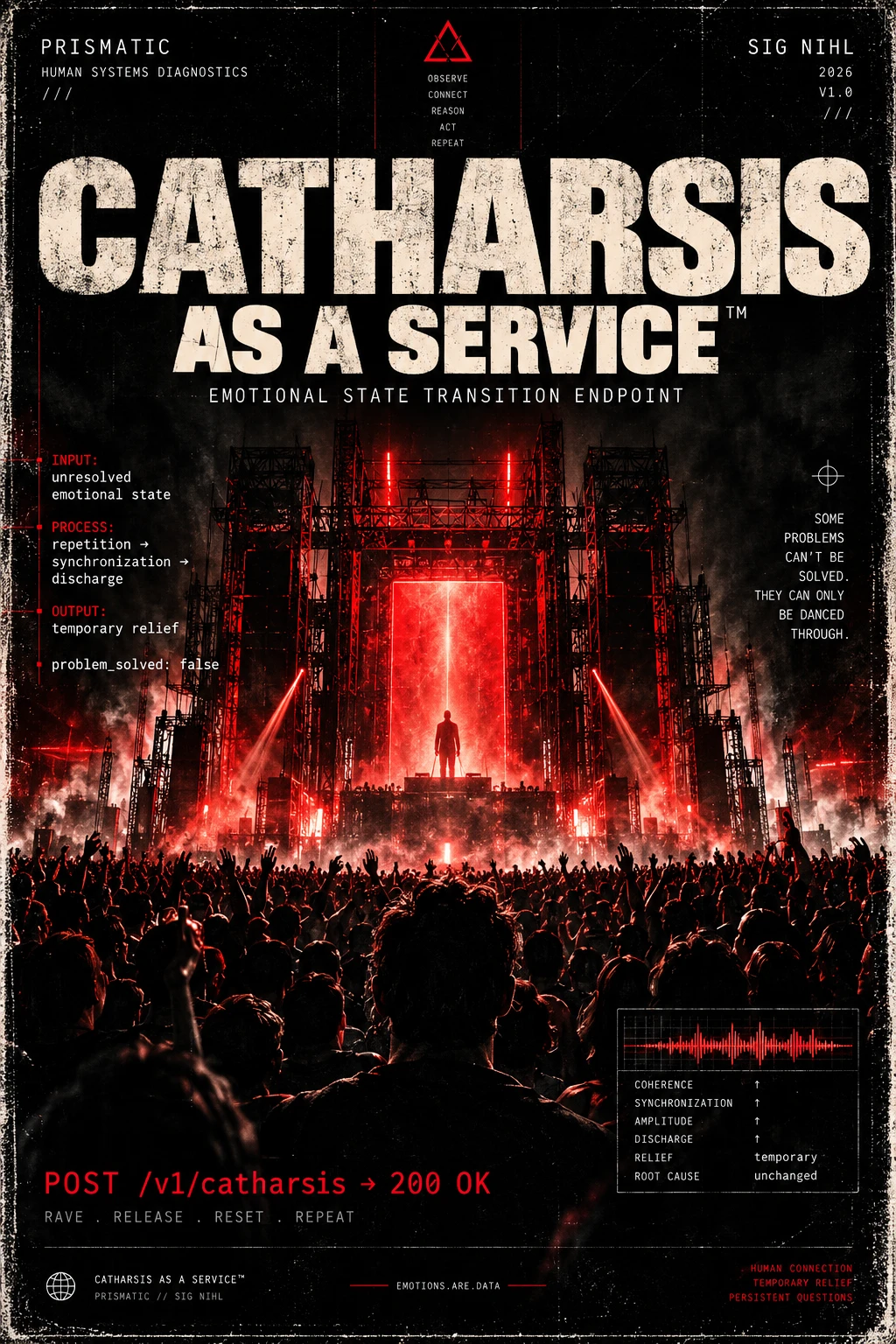
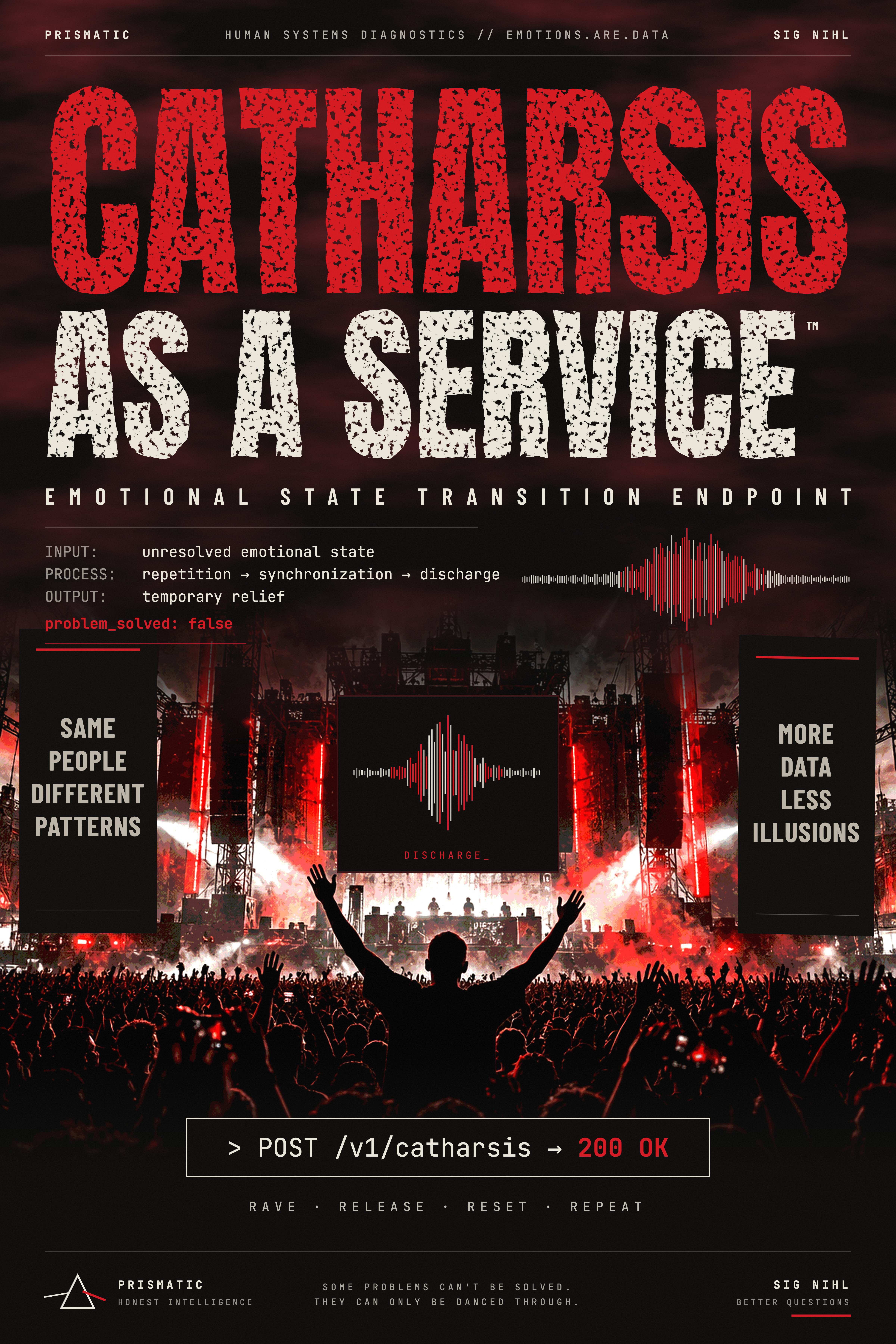
Catharsis as a Service poster showing a monumental red-lit industrial rave stage, a dense crowd and a central anonymous figure beneath diagnostic telemetry. Open artwork viewer
Input:
unresolved emotional state
Process:
repetition → synchronization → discharge
Output:
temporary relief

> POST /v1/catharsis 200 OK

problem_solved: false

relief detected ≠ cause resolved

A case study in supervised, verifiable development.

Catharsis as a Service™ was created primarily as a technical demonstration and case study: for Majordomus (majordomus.dev), a supervisory control layer for AI-assisted development, and for Prismatic, as an example of development in which every public statement is sourced, graded and checkable. The artwork and the research library are the material on which both are demonstrated.

A demonstration is only as good as the records behind it, so this page asks for no trust. The build history, the sources behind each claim and the rules the work followed are public, and every item below links to the record it describes.

The subject matter is handled as academic work, not as marketing. The library summarises classical sources and peer-reviewed research at group level, grades the strength of that evidence and states its limits. It is an educational publication, not a medical resource, and it does not assess or advise individuals.

Case 01 · Majordomus

AI-assisted development under supervision

The site was written by an AI coding agent directed by one person. Majordomus scoped each task to declared paths, recorded its progress and accepted a task as finished only when its verification command passed.

  • Two scope errors and one bootstrap failure were reported locally before the first push; the method note gives the recorded timeline.
  • Rules, workflows and context for any AI worker are kept in a provider-neutral .ai/ directory, versioned with the code.
  • A deployment counts as complete only after the Pages workflow has verified the live URL, and a release is cut only after that check.

Case 02 · Prismatic

Development that can be verified

Content is held to the same standard as code. A claim may be published only when the evidence ledger records it with appraised sources, an evidence level no stronger than its best source and a review date that has not passed; otherwise the build fails.

  • Journal articles in the bibliography must carry a DOI, and references are checked against Crossref.
  • Overclaiming phrases listed in the content standards, missing clinical disclaimers and gaps between the English and Czech editions fail validation or the end-to-end tests.
  • Every command mentioned in the documentation is registered together with the test that runs it.

Check it yourself

  • 01

    Source code

    The repository with its full commit history, validators, tests and workflow definitions.

  • 02

    Pipeline runs

    Validation, deployment and verification against the live URL for every push to main.

  • 03

    Releases

    A release is published only after the live site has passed verification.

  • 04

    Build status

    The revision and content version of this build and the current statistics of the evidence ledger.

  • 05

    Evidence ledger

    Every claim with its type, evidence level, confidence, sources and review date.

  • 06

    API

    A versioned JSON export of the pages, the evidence ledger and the glossary.

Relief is not resolution.

Catharsis as a Service™ is an artwork and an evidence library about one widespread confusion: the belief that feeling released means that something has been resolved.

The piece starts from an ordinary experience. After a concert, a long run, an argument that ends in shouting or a night of dancing, many people feel lighter, and the feeling is real, even when the body is still activated. What the site questions is the inference that often follows, that the lightness means the thing that weighed on them has been dealt with.

That inference matters because it shapes behaviour. If relief is read as resolution, the relieving activity is repeated whenever the pressure returns, and the pressure keeps returning because nothing about its source has changed. Learning theory calls this negative reinforcement; everyday language calls it coping that has quietly stopped working.

The library does not argue against relief. It separates three questions that are usually merged into one: what changed in the body, what changed in understanding, and what changed in the situation. Every research note, theory essay and advice entry is written to keep those questions apart.

The problem it addresses

Contemporary culture sells emotional release as a solution: a night out, a playlist, a scream, a purchase. The sense of relief is real and often valuable. The difficulty lies in what it is mistaken for. When relief is treated as resolution, people repeat what helps in the moment and are left puzzled when the underlying difficulty returns. Psychological research has examined this gap for decades, yet its findings rarely reach the places where release is sold.

Who it is for

  • People who rely on intense experiences to cope and want to understand what those experiences do and do not do.
  • Readers interested in the psychology of emotion, emotion regulation and collective behaviour.
  • Artists, designers and technologists who work with the language of data, wellbeing and self-optimisation.

The approach

Artwork
A poster and an interactive page that present collective euphoria and then describe it as a service transaction.
Evidence
Research notes that summarise classical sources and peer-reviewed studies, each with its references.
Practice
Advice entries graded by the strength of their evidence, with concrete steps and explicit limits.

The body can change statewithout the worldchanging with it.

Heart rate settles, muscles loosen, a crowd disperses and a person reports relief. All of that can be real, and much of it can be recorded. None of it shows that the debt, the conflict, the loss or the working conditions behind the distress have changed. That gap is the whole argument of the artwork, stated as plainly as possible.

Physiological recovery is a normal and valuable process. After a stress response, heart rate, blood pressure and stress hormones return towards their baseline, and a prolonged failure to return is associated with cumulative wear on the body. Recovery is worth protecting.

Recovery, however, describes the organism, not its circumstances. A person can sleep, run, cry, sing or dance their way back to baseline while the rent is still unpaid, the relationship still unrepaired and the loss still a loss. The line relief detected ≠ cause resolved is a reminder to ask about both.

> relief detected ≠ cause resolved

Artistic Poster series

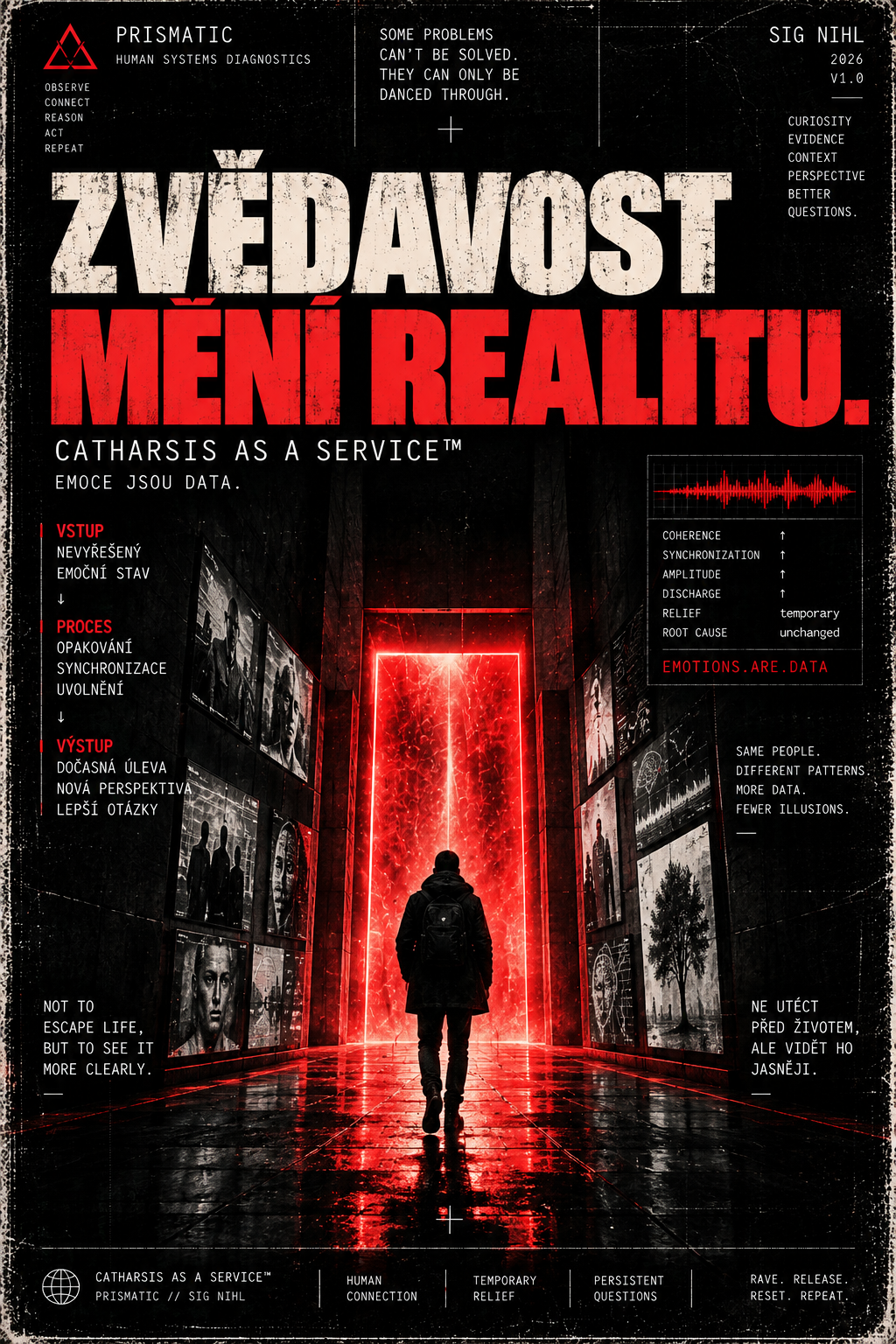
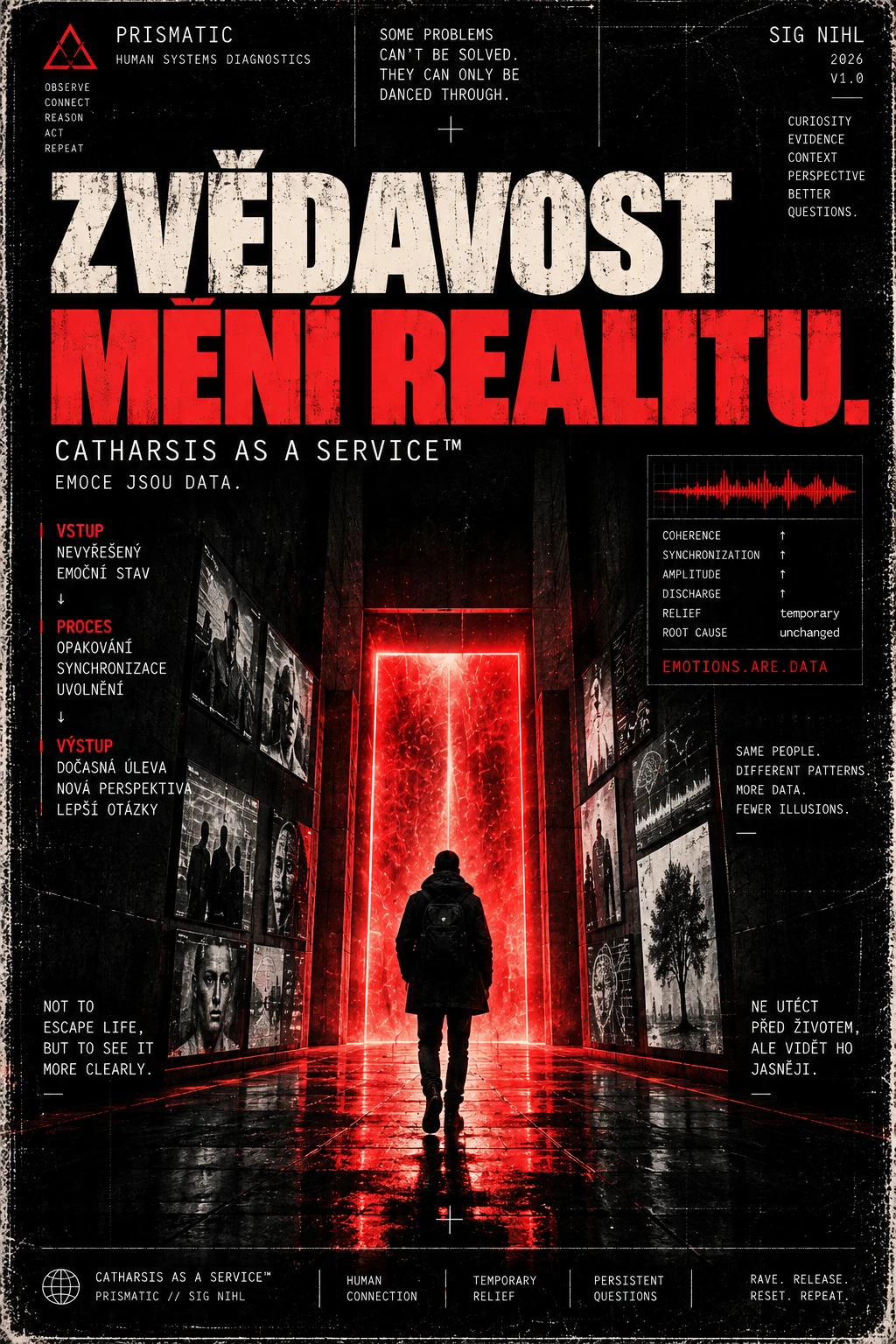
  • Poster in black and red: the Czech headline ZVĚDAVOST MĚNÍ REALITU (curiosity changes reality) above a figure walking towards a glowing red doorway between walls of screens; side panels list input, process and output, and an artistic telemetry box ends with root cause: unchanged.

    Curiosity changes reality Not to escape life, but to see it more clearly.

From the Catharsis as a Service poster series. Slogans and numbers on the posters belong to the artwork; they are not findings.

A felt release, and an open empirical question.

In this project, catharsis is a subjectively felt release of emotional tension that follows expression, physical exertion or immersion in an experience. Whether the cause of that tension changes is a separate question, and the answer depends on the emotion, the method and the context.

The word has travelled far from its origin. In Aristotle it described what tragedy does to an audience, and scholars still disagree whether he meant a purging, a purification or a clarification of emotion. Breuer and Freud borrowed it for a clinical method in which recalling a painful memory with strong emotion relieved symptoms, at least for a while.

Popular culture of the twentieth century turned the idea into a hydraulic picture: emotion builds up like pressure and must be let out, or it will burst out somewhere else. The picture is intuitive and still common in advice about anger, grief and stress. Experimental psychology has tested it many times, and in its simple form it has not held up.

What remains is a narrower and more useful idea. Expressing emotion tends to help when it adds something: support from other people, a new understanding, a different appraisal of the situation, or a decision to act. Expression that only rehearses the emotion tends to keep it going.

  • c. 335 BCE

    Classical

    Aristotle describes tragedy as achieving, through pity and fear, the katharsis of such emotions. Scholars still debate whether he meant purgation, purification or clarification.

  • 1895

    Clinical

    Breuer and Freud's cathartic method relieved symptoms through the discharge of emotion, known as abreaction. Freud later abandoned it, partly because relief was often temporary.

  • 1986 to today

    Empirical

    Controlled studies show that venting anger increases aggression, while emotional expression helps when it adds social support, understanding or regulation.

  1. c. 335 BCE Aristotle, Poetics: katharsis through pity and fear
  2. 1895 Breuer and Freud: the cathartic method and abreaction
  3. 1986 Pennebaker and Beall: writing about trauma and health
  4. 1998 Gross: the emotion regulation framework
  5. 1999–2002 Bushman and colleagues: venting anger does not reduce aggression
  6. 2009–2015 Synchrony research: shared rhythm and social bonding

Six milestones from Aristotle's Poetics to research on synchrony and social bonding.

How catharsis moved from aesthetics to clinical method to an empirical research question.

The relief loop.

The artifact models collective catharsis as a four-stage process. Each stage has a documented psychological or physiological basis, and none of them requires the original problem to change.

The model is deliberately simple, so that each step can be checked against research. Repetition and rhythm narrow attention; moving in time with others is associated with closeness and higher pain thresholds; physical and musical peaks are followed by a strong sense of release. None of these steps requires the original difficulty to change.

The loop closes because relief is rewarding. Whatever reliably comes before relief becomes more likely next time, which is why the same ritual can be sought again and again. On the interactive models page you can change the size of the relief and the chance that the cause changes, and watch the urge to repeat grow or fade.

  1. 01

    Unresolved state

    Stress, grief, anger or anxiety with a cause that lies outside the moment.

  2. 02

    Repetition

    Rhythm and repeated movement narrow attention and interrupt rumination for a while.

  3. 03

    Synchronization

    Moving in time with others increases closeness and cooperation and raises pain thresholds.

  4. 04

    Discharge

    Exertion and musical peaks produce an acute lift in mood and a strong sense of release.

The relief loopAn unresolved state leads to repetition, synchronization and discharge. Discharge produces temporary relief, and the unchanged state leads back to the start.Unresolved stateINPUTRepetition01Synchronization02Discharge03Temporary relief200 OKroot cause unchangedproblem_solved: false
The loop implied by negative reinforcement: relief makes the sequence more likely to repeat while the unresolved state returns.
Two trajectories of distress over timeLine chart with time on the horizontal axis and distress on the vertical axis. One curve peaks, drops during discharge and returns to baseline; the other declines gradually to a lower level.timedistressbaselinedischarge, then returnprocessing
Discharge versus processing. A conceptual illustration of the argument, not measured data.

Release is not the same as blowing off steam.

Catharsis names a felt release. Venting names a strategy: expressing anger through high-arousal activity in the expectation that it will drain away. The two are often treated as one, and the evidence separates them.

Raising arousal

Activities that increase arousal

g = −0.02

Across studies, activities that raised physiological arousal did not reliably reduce anger or aggression; the confidence interval spans zero.

Lowering arousal

Activities that decrease arousal

g = −0.63

Activities that lowered arousal were associated with a moderate reduction in anger and aggression across studies and samples.

studies
154
samples
184
participants
10,189

Kjærvik, S. L., & Bushman, B. J. (2024). Meta-analysis in Clinical Psychology Review, 109, 102414.

The felt release after shouting or pounding something is real. What the evidence does not support is the expectation that discharging arousal reduces the anger that follows. Lowering arousal first, and then working with the situation, does better.

The distinction has practical consequences. Advice to hit pillows, scream into cushions or get anger out through exhausting effort rests on the hydraulic picture. Controlled studies suggest that bringing arousal down first, and then thinking about the situation from some distance, is the more reliable route to calmer feelings and less aggression.

None of this makes physical activity or strong feeling suspect. Exercise has its own benefits for mood, and shouting at a concert is not a clinical problem. The point is narrower: when the goal is to reduce anger, the method that feels most like release is not the one that works best.

Artistic Poster series

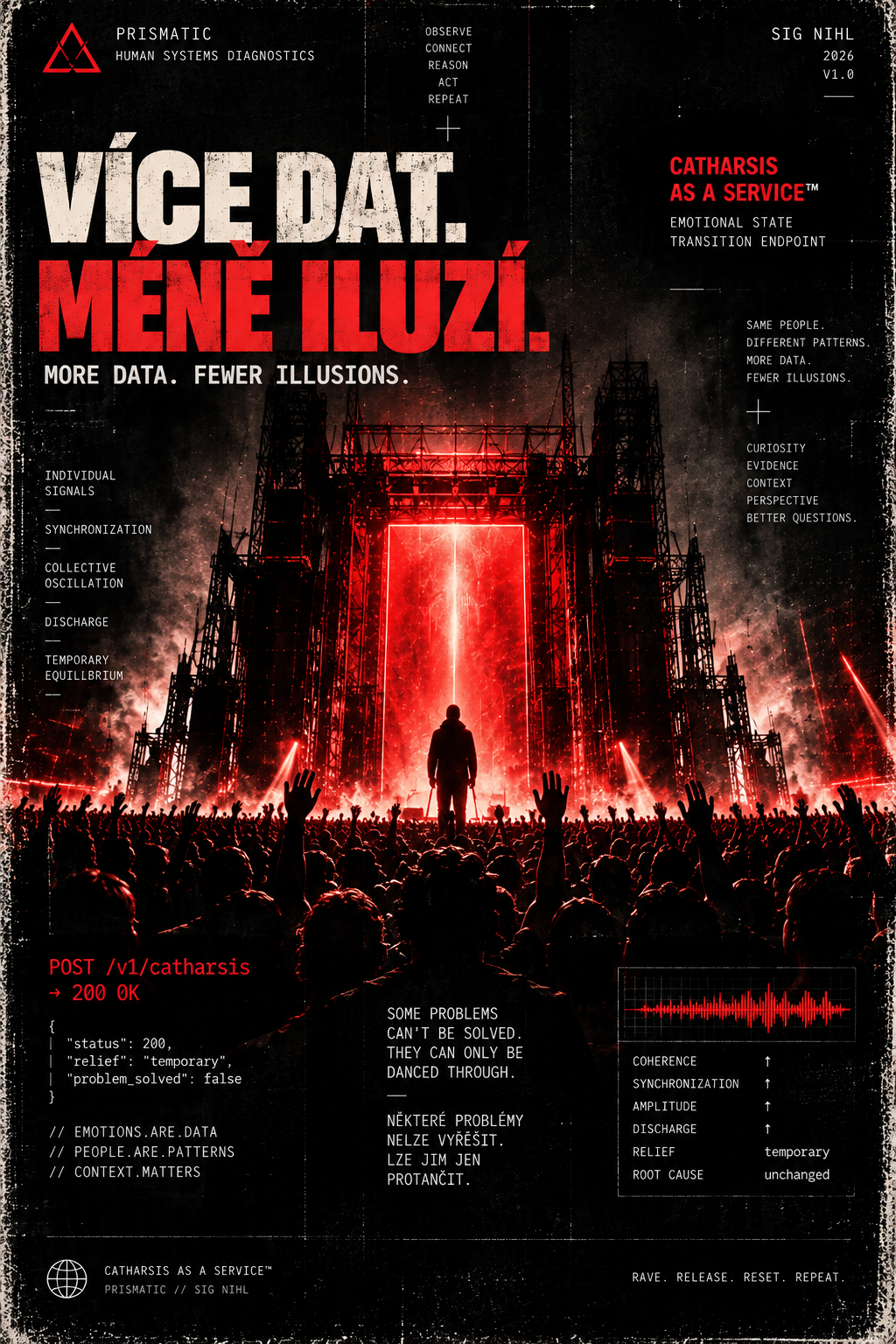
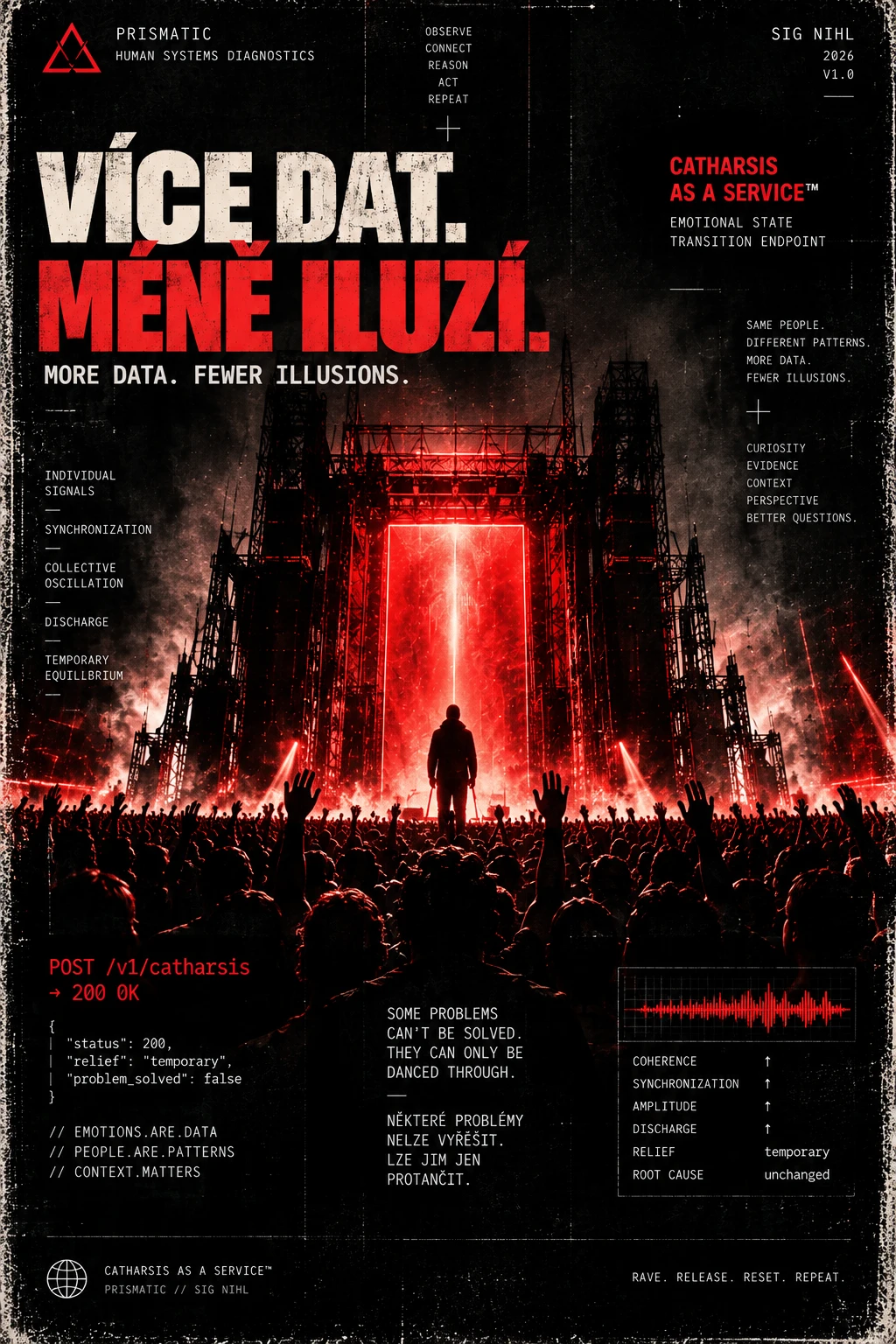
  • Poster: VÍCE DAT. MÉNĚ ILUZÍ. (more data, fewer illusions) over a crowd with raised hands in front of a stage with a glowing red gate; below, the request POST /v1/catharsis → 200 OK with problem_solved: false and an artistic telemetry panel.

    More data. Fewer illusions. The endpoint answers, the crowd dances, the root cause stays unchanged.

From the Catharsis as a Service poster series. Slogans and numbers on the posters belong to the artwork; they are not findings.

The endpoint works.The problem remains.

  1. Inputunresolved emotional state
  2. Processrepetition · synchronization · discharge
  3. Outputtemporary relief
HTTP status
200 OK
State transition
Complete
Relief
Temporary
Problem status
Unresolved
{
  "endpoint": "/v1/catharsis",
  "method": "POST",
  "input": {
    "emotional_state": "unresolved"
  },
  "process": [
    "repetition",
    "synchronization",
    "discharge"
  ],
  "output": {
    "relief": "temporary"
  },
  "status": 200,
  "problem_solved": false
}
  1. 01Individual signals
  2. 02Synchronization
  3. 03Collective oscillation
  4. 04Discharge
  5. 05Temporary equilibrium

A crowd does not solve the unresolved state.

It synchronizes it.

For a brief interval, individual noise becomes collective rhythm.

More data. Fewer illusions.

Conceptual metrics. These are artistic values, not biometric measurements. Nothing on this page measures anyone.

More data. Fewer illusions.
SignalValue
Input stateunresolved
Coherencerising
Synchronizationhigh
Amplitudehigh
Dischargedetected
Relieftemporary
Root causeunchanged

For different questions.

The same claims, models and sources serve every reader here. What changes with the view you pick is how much of the apparatus around them is unfolded: the assumptions, the populations, the equations, the implementation, or what the signals cannot settle.

  • I want to understand what catharsis actually is.

    The question, something to try, what it means in plain language, and the one limit that matters most.

  • I work with people and need to know what is supported.

    What the evidence supports, in which population, with which limits, how strong it is and when it was last reviewed.

  • I want to inspect the research.

    The rules a model applies, the assumptions behind them, where each parameter came from, and the studies underneath.

  • I design intense collective experiences.

    The mechanism as something that can be designed for: arousal, synchrony, endings, belonging, and what the effect is not.

  • I want to inspect the models and the implementation.

    The model as code: its identifier, its inputs and outputs, the implementation, the tests that hold it and the seed that makes a run repeatable.

  • I care about what can actually be inferred from signals.

    What was observed, what was derived from it, what is only inferred, what is assumed, what is illustrative and what stays unknown.

Nothing is hidden from any view and no view has its own facts. A statement that is true under one is true under all of them; the view decides how much of its basis is shown at once.

What the research shows.

The research notes separate what studies found from what remains uncertain. Four findings frame the whole project.

Every claim on the site is recorded in an evidence ledger with its type, an evidence level from A to E, a confidence rating and a date by which it must be reviewed again. A claim is never graded more strongly than its best source, and the build fails when a review date passes.

Grades describe the strength of the underlying study designs, not the importance of a topic. Much of what matters about catharsis, grief and collective experience has been studied mainly with correlational or qualitative designs, and the ledger says so rather than presenting those findings as experiments.

  • Venting increases aggression

    Hitting a punching bag while thinking about a provocation produced more anger and aggression than sitting quietly.

    Bushman, 2002

    Read the note
  • Synchrony builds bonds

    Group dance in synchrony raised pain thresholds and increased reported closeness to the group.

    Tarr et al., 2015

    Read the note
  • Talking alone is not enough

    Talking about an emotional experience felt helpful but did not reduce its emotional impact without cognitive work.

    Zech & Rimé, 2005

    Read the note
  • Debriefing did not prevent PTSD

    A Cochrane review found no preventive effect of single-session debriefing and some evidence of harm.

    Rose et al., 2002

    Read the note

Research notes

From evidence to practice.

Recommendations, each graded by the strength of its evidence and paired with concrete steps and explicit limits. They are general education, not a treatment plan.

The advice is written for adults thinking about their own habits. Each entry states how strong the evidence behind it is, what to do in concrete steps, and where the recommendation stops applying. None of it replaces individual help, and several entries name the situations in which a professional is the right next step.

Open the advice library

Nine ways into the library.

The artwork asks a question; the library answers it at different depths. Start where your question is: a finding, a theory, a model you can change, a practical step, the grading behind a claim, a term, or a search across everything.

  • 01

    Research notes

    What studies found about venting, synchrony, crying, grief, sleep, exercise and measurement, with limits stated next to findings.

  • 02

    Theory

    The frameworks behind the findings: catharsis theories, the process model of emotion regulation, appraisal, constructed emotion, avoidance learning, allostasis and ritual.

  • 03

    Interactive models

    Five small simulations of relief, arousal, remembered discomfort, synchrony and stress load, labelled as illustrations rather than predictions.

  • 04

    Advice

    Evidence-graded recommendations with concrete steps and explicit limits, written for adults thinking about their own habits.

  • 05

    Evidence ledger

    Every claim with its type, level, confidence, sources and review date, and a changelog of what was revised.

  • 06

    Glossary

    Psychological, physiological and methodological terms defined in plain language, linked to notes and sources.

  • 07

    Search

    Find notes, essays, advice and terms in either language; matching ignores accents and runs in your browser.

  • 08

    Case study

    How the site was built with an AI coding agent under Majordomus supervision, with an interactive timeline of the real task, commit, pipeline and release records.

  • 09

    Engineering

    Technical articles on the architecture, the evidence ledger as code, testing, parallel agents, interactive models and an honest account of time spent and saved.

Better questions than: did it help?

Whether an experience felt good is the easiest question and the least informative one. These questions follow the research on emotion regulation and on what happens after relief.

Good questions keep relief and resolution apart without dismissing either. They are not tests to pass. They are ways of noticing whether a habit still does what it is used for.

  1. Did I feel better?

    What exactly changed: my body, my mood, my understanding, or the situation?

  2. Should I let it all out?

    Does expressing this lower my arousal and lead somewhere, or does it keep me rehearsing the provocation?

  3. Why does it keep coming back?

    What did the relief make easier to avoid?

  4. Is this normal?

    Is it lasting longer, growing stronger, or disrupting sleep, work or relationships?

  5. How do I get that high again?

    Which parts of that experience, such as movement, music or other people, can I bring into an ordinary week?

  6. Did the night out fix it?

    What is one concrete step toward the cause, and who could take it with me?

Artistic Poster series

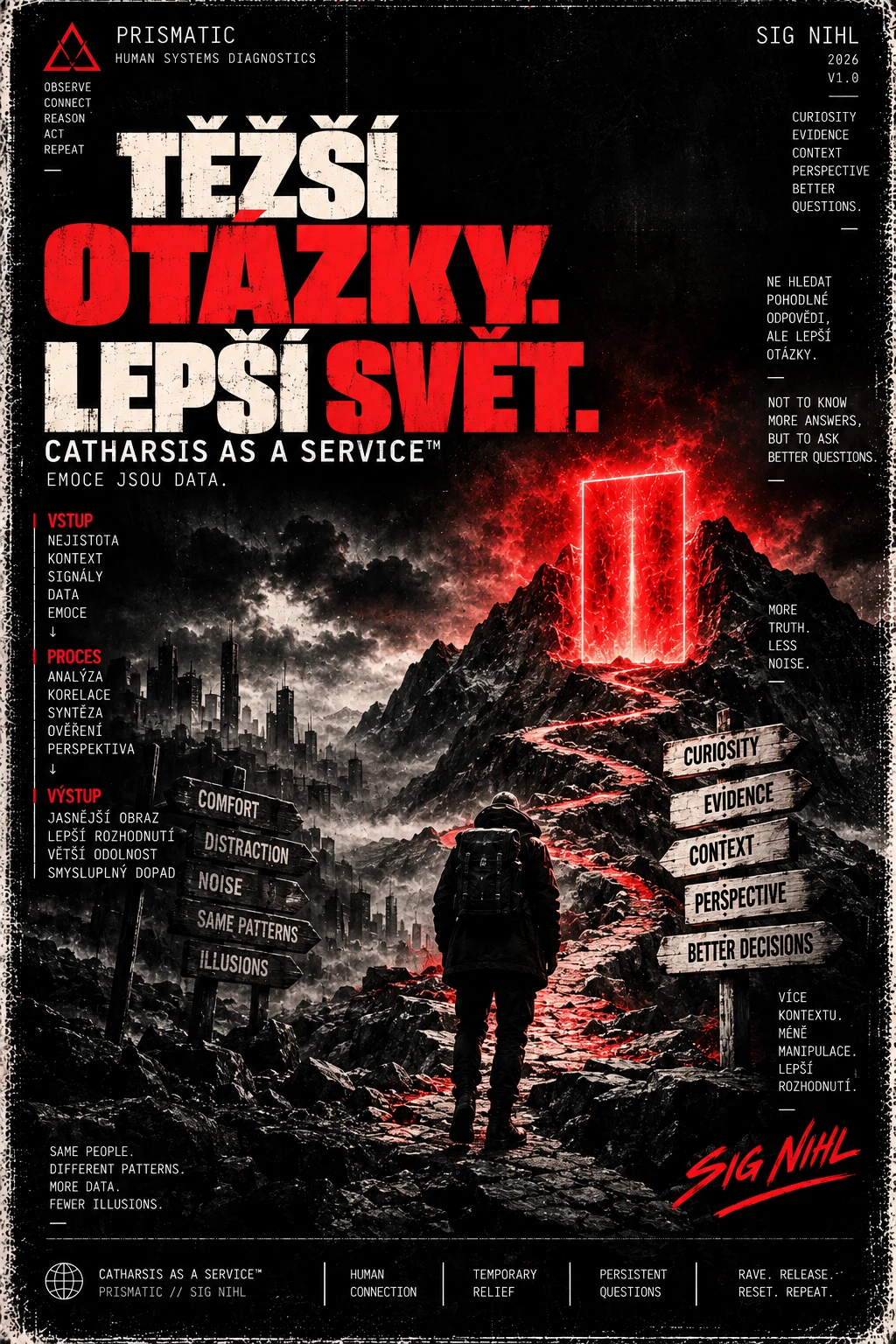
  • Poster: TĚŽŠÍ OTÁZKY. LEPŠÍ SVĚT. (harder questions, a better world). A hiker climbs a glowing red path towards a doorway on a mountain; signposts on the left read comfort, distraction, noise, same patterns and illusions, on the right curiosity, evidence, context, perspective and better decisions.

    Harder questions. A better world. Not to know more answers, but to ask better questions.

From the Catharsis as a Service poster series. Slogans and numbers on the posters belong to the artwork; they are not findings.

Where this site stops.

This is an educational publication. It summarises group-level research, it cannot assess an individual, and nothing on it measures you. Some experiences need a qualified professional rather than an article.

Descriptions of research here are about groups of people studied under particular conditions. They cannot say what a particular reader is going through or what will help them. If what you are experiencing is severe, lasting or frightening, the most useful step is to talk with someone qualified who can listen to your situation.

Contact a qualified professional if

  • distress lasts for weeks or keeps intensifying
  • sleep, work, study or relationships are disrupted
  • relief depends on alcohol, drugs or risky behaviour
  • a traumatic event keeps returning as intrusive memories, nightmares or avoidance

If you have thoughts of harming yourself or someone else, contact local emergency services or a crisis line now.

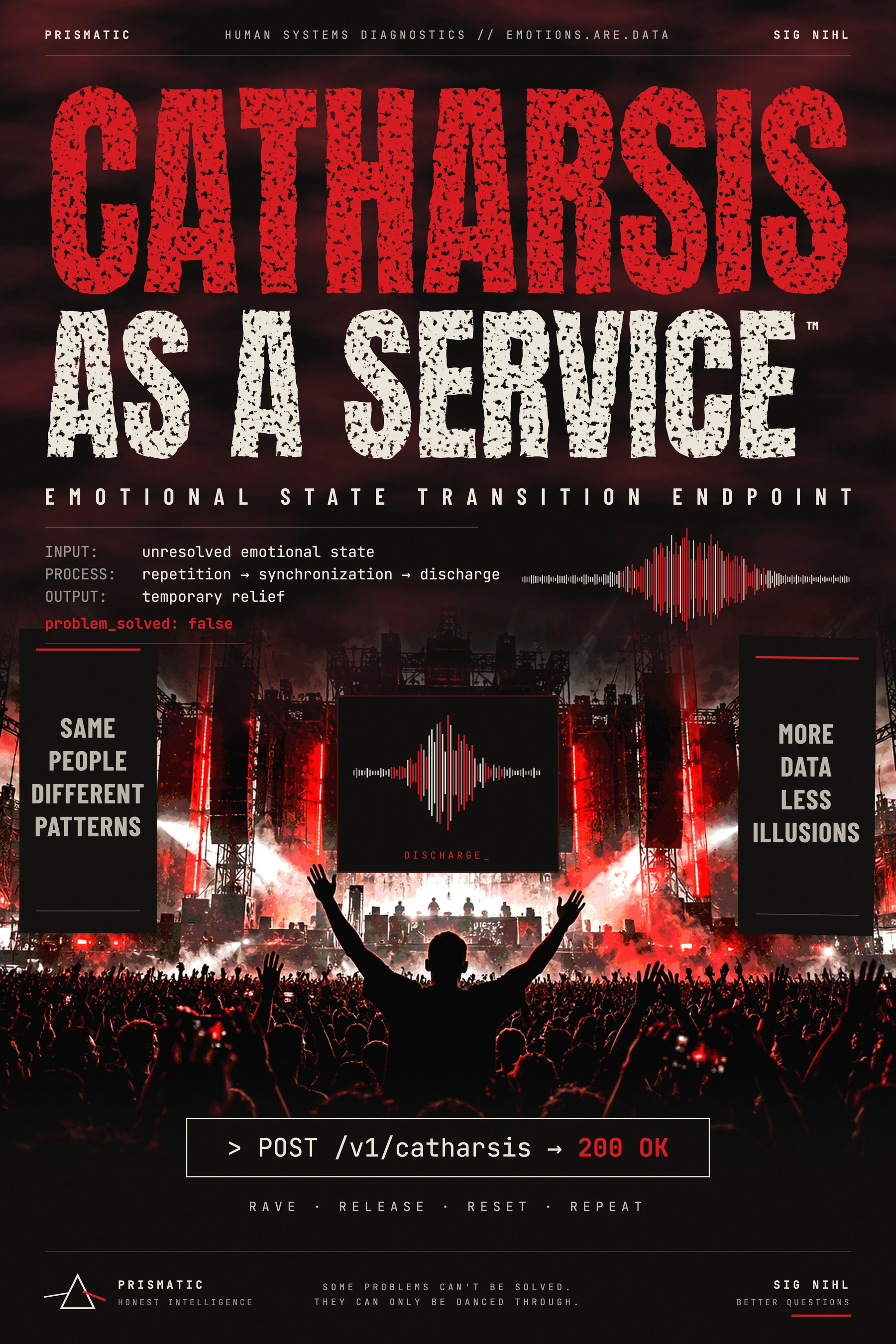
Catharsis as a Service poster showing a monumental red-lit industrial rave stage, a dense crowd and a central anonymous figure beneath diagnostic telemetry. Open artwork viewer

Catharsis as a Service™

A visual study that presents collective euphoria at first glance and a diagnosis of it at second.

Photography of an industrial rave, brutalist typography and a Prismatic telemetry overlay share one surface. The crowd gets its release, the system logs a successful response, and the underlying condition stays exactly where it was.

First glance, second glance

Seen from across a street, it is a campaign: a red-lit stage, a sea of raised hands, a headline big enough to promise something. That reading is intended and it is not a trap. The night it advertises is real, and so is the relief.

Seen up close, the poster starts filing a report. The overlay names an input, a process and an output. The status line reads as a success: 200 OK. Underneath it, one field refuses to cooperate: problem_solved: false.

Why an API

Service language is how we describe things meant to be consumed on demand, repeatably, with a predictable response. Putting catharsis behind an endpoint makes one uncomfortable property visible: the transaction can succeed completely without the request ever being resolved. The endpoint does exactly what it promises. The promise was just smaller than the need.

Relief is not resolution

The artifact does not argue that dancing is useless or that collective release is fake. Repetition, synchronization and discharge are old and effective human technology. The claim is narrower: a temporary state transition and a removed root cause are different outcomes, and it is worth being able to tell which one you received.

Why the telemetry is conceptual

Every metric on this page is an artistic value. Nothing is measured, collected or inferred about anyone who visits, and there is no analytics script to contradict that. A piece about instrumenting people should not quietly instrument its own audience.

How to use it

  • As a mirror: after the next night that felt like it fixed something, ask which field it actually changed.
  • As a conversation starter: the raw response is short enough to quote and specific enough to disagree with.
  • As a design reference: euphoria and diagnosis on one surface, with neither cancelling the other.
Dimensions
4800 × 7200 px
Format
PNG
Download master PNG

Artistic Poster series

  • Poster: CATHARSIS AS A SERVICE™, emotional state transition endpoint, above a stage gate glowing red over a dense crowd; the left panel lists input, process, output and problem_solved: false; at the bottom POST /v1/catharsis → 200 OK and an artistic telemetry box.

    English edition Rave. Release. Reset. Repeat.

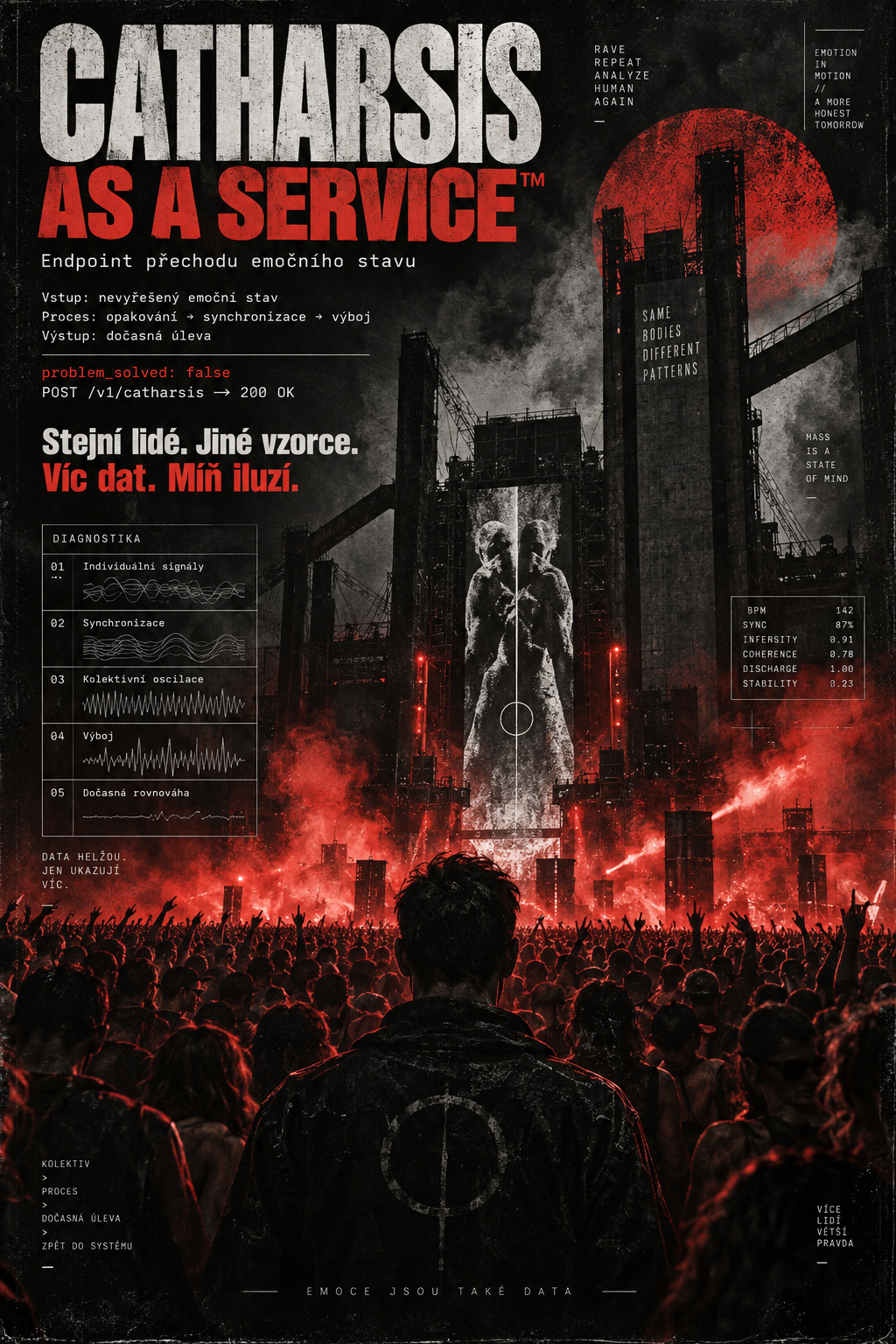
  • Poster: CATHARSIS AS A SERVICE™ with the Czech subtitle Endpoint přechodu emočního stavu; industrial towers with a projected pair of figures rise above a red-lit crowd, and a Diagnostika panel lists individual signals, synchronization, collective oscillation, discharge and temporary equilibrium.

    Czech edition Same people. Different patterns. More data. Fewer illusions.

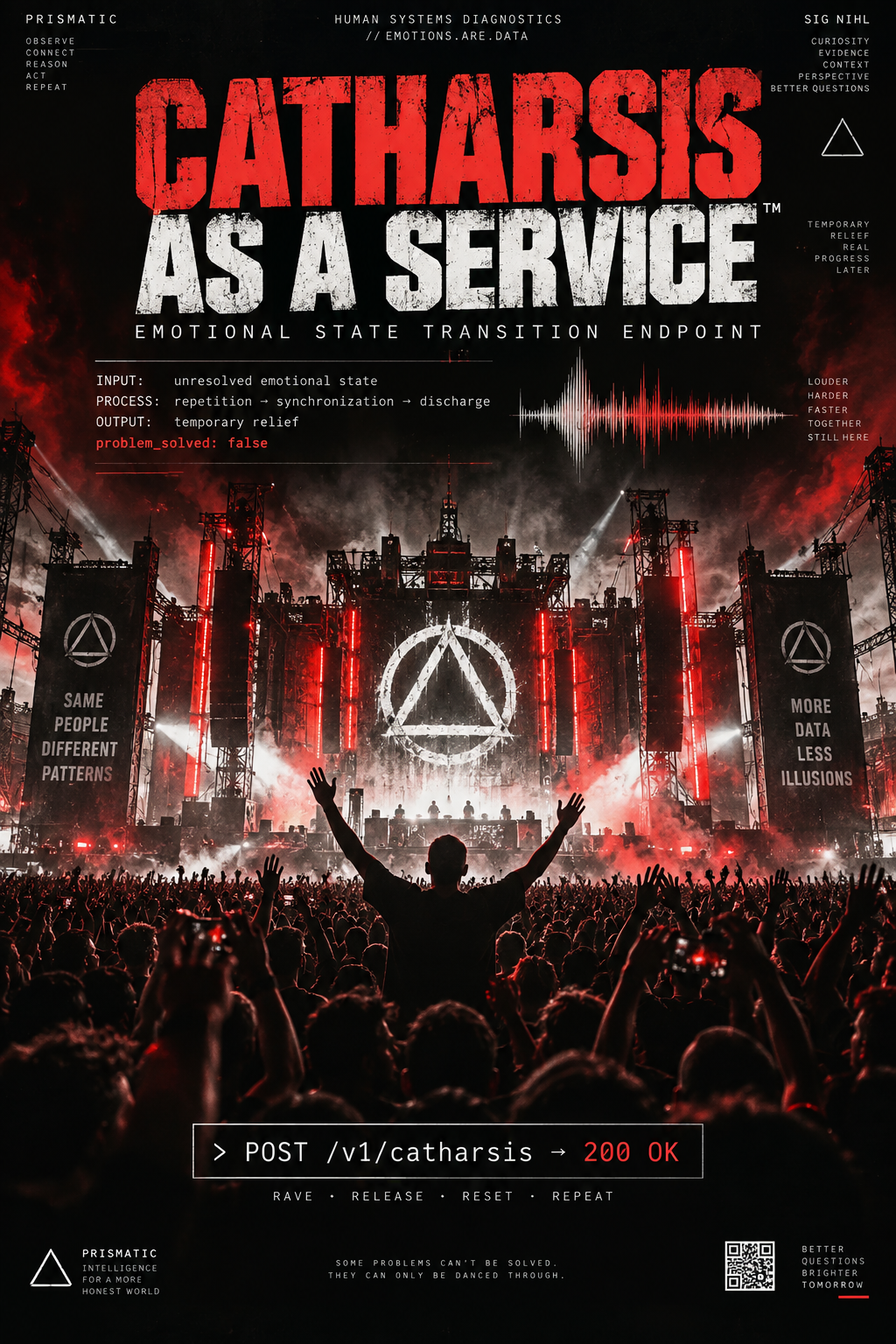
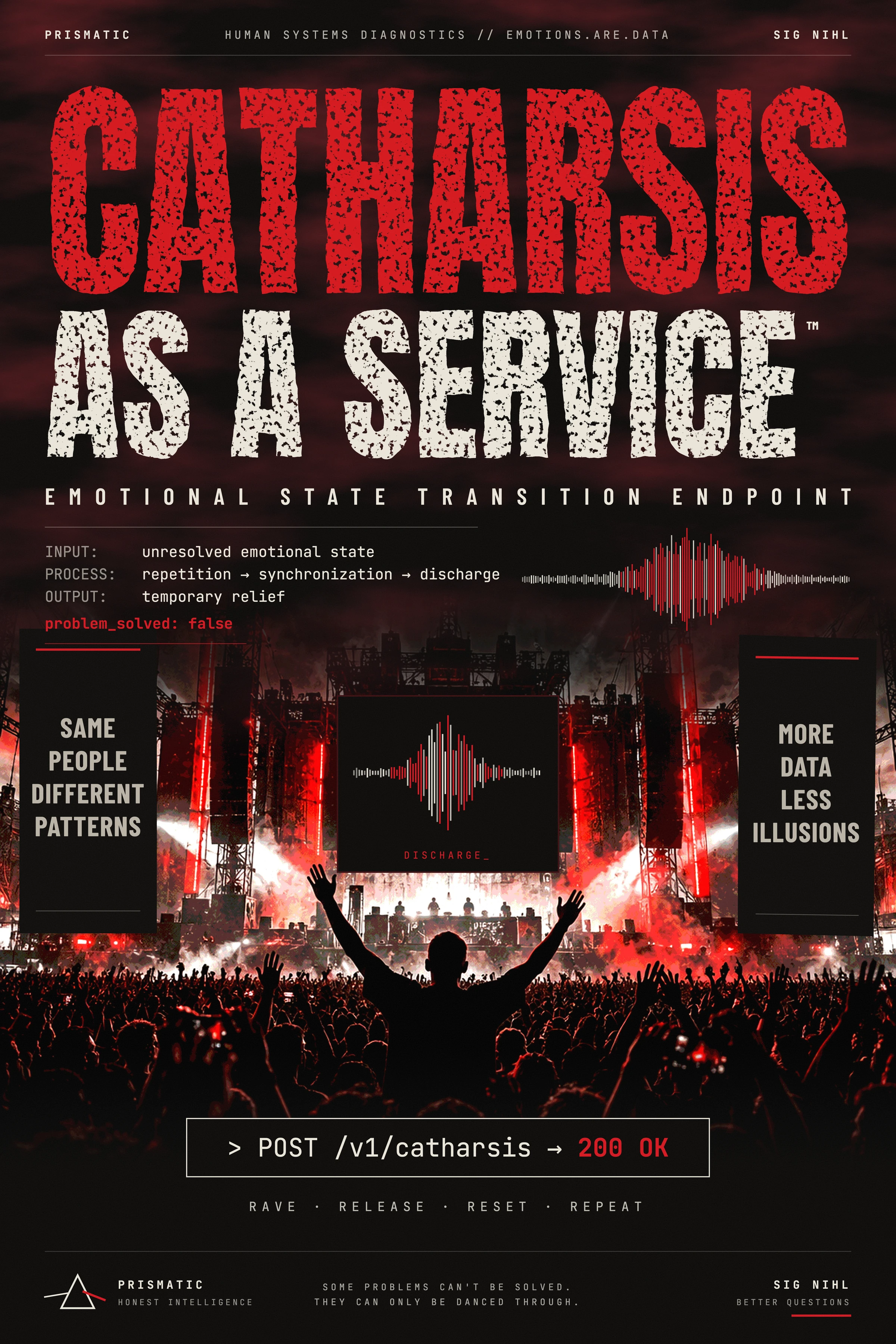
  • Poster: CATHARSIS in red and AS A SERVICE™ in white above a stage framed by triangle-in-circle emblems and banners reading same people different patterns and more data less illusions; a figure raises both arms before the crowd; POST /v1/catharsis → 200 OK.

    Signal edition Some problems can't be solved. They can only be danced through.

From the Catharsis as a Service poster series. Slogans and numbers on the posters belong to the artwork; they are not findings.

Same people. Different patterns.

Request
$ curl -X POST /v1/catharsis \
    -d emotional_state=unresolved
Response
HTTP/1.1 200 OK

{
  "relief": "temporary",
  "problem_solved": false
}

Rave.Release.Reset.Repeat.

Some problems can't be solved.They can only be danced through.

First release in one session. Verified before every claim.

The site was written by an AI coding agent directed by one person and supervised by Majordomus, a control layer that scopes each task, records progress and refuses to close work that has not been verified on the live site.

The supervision layer made the work slower in small ways and faster in large ones. Every task had a declared scope, every completion claim had a verification command, and every deployment was checked against the live site before a release was published. Mistakes surfaced as local findings instead of broken pages.

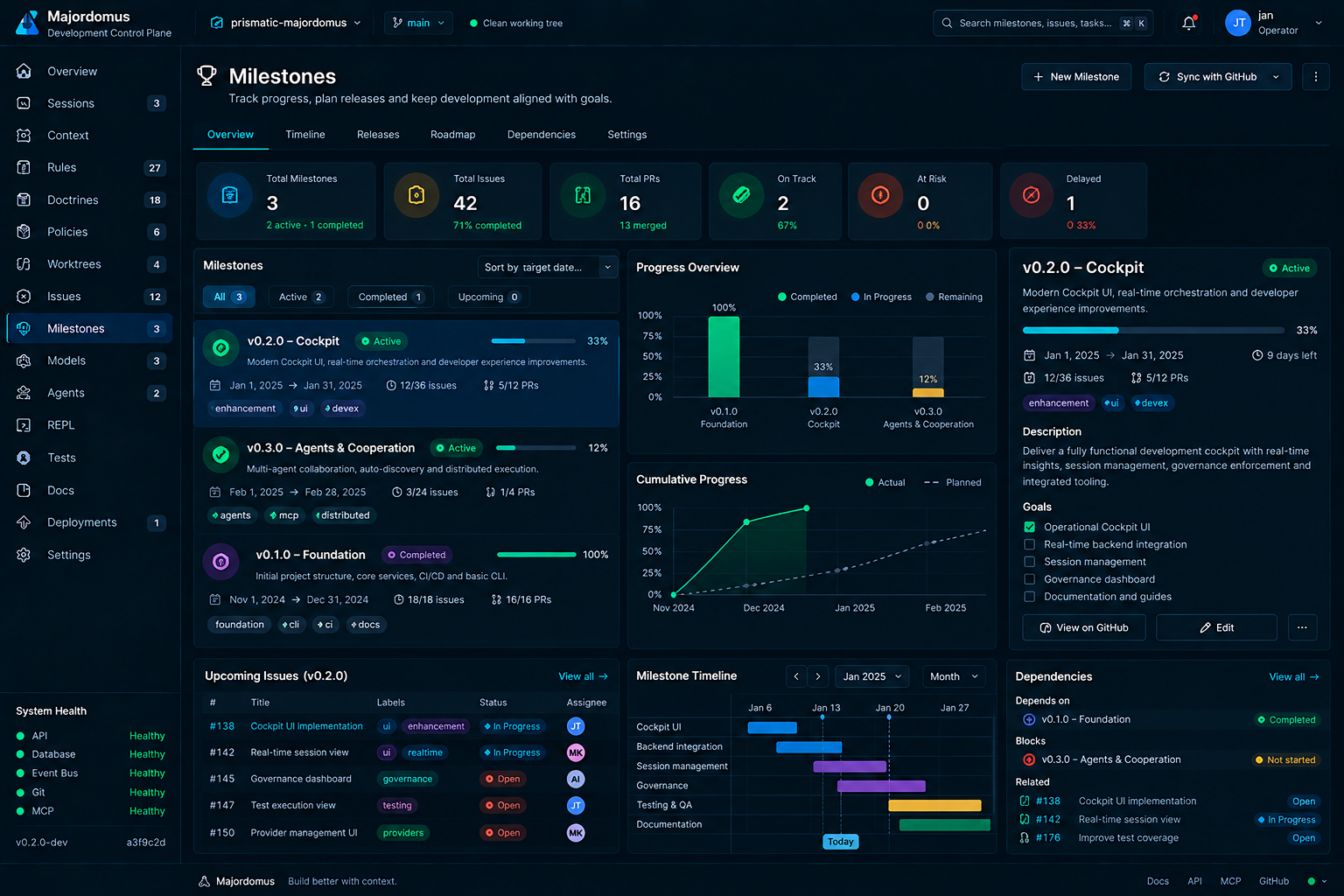
The concept screens show where the tooling is heading: a cockpit over sessions, rules, tests and milestones. Their data is illustrative. The real records of this project are its commits, its pipeline runs and the method note.

from an empty repository to the first verified release
51 min 36 s
from Majordomus initialisation to that release
19 min 19 s
from push to a verified, published release
2 min 57 s
pipeline jobs passed on the first deployment
7 / 7

Concept screens · illustrative data

  • Concept screen of the Majordomus cockpit Sessions view: a list of working sessions and the timeline of one session from start to updated documentation, with the context sources it loaded.

    Sessions Each session keeps its timeline, context sources, decisions and handover.

  • Concept screen of the Majordomus cockpit Tests view: pass and fail counts, a results trend, coverage, quality gates and live test output.

    Tests Test runs, failures and quality gates in one place, linked to issues and commits.

  • Concept screen of the Majordomus cockpit Milestones view: three milestones with progress bars, a cumulative progress chart, a timeline and dependencies.

    Milestones Milestones with progress, schedule and dependencies derived from the issue plan.

Concept screens of a Majordomus cockpit for sessions, tests and milestones. The data in them is illustrative and does not describe this project; the measured timeline is in the method note.
  • Two scope errors and one bootstrap failure were caught locally before the first push.
  • Every push to main is validated, deployed, verified in a real browser against the live URL and released automatically.
  • No speed-up factor is claimed: there was no control condition, and the method note explains what the records can and cannot show.

Frequently asked questions.

Catharsis is the idea that expressing an emotion reduces its intensity. The term comes from Aristotle's Poetics, and Breuer and Freud later used it for a clinical method of emotional discharge. Research shows that the feeling of release is real, while its effect on the underlying emotion depends on the emotion and on whether expression includes support, understanding or regulation.