Prismatic × Sig Nihl // Human Systems Diagnostics
About
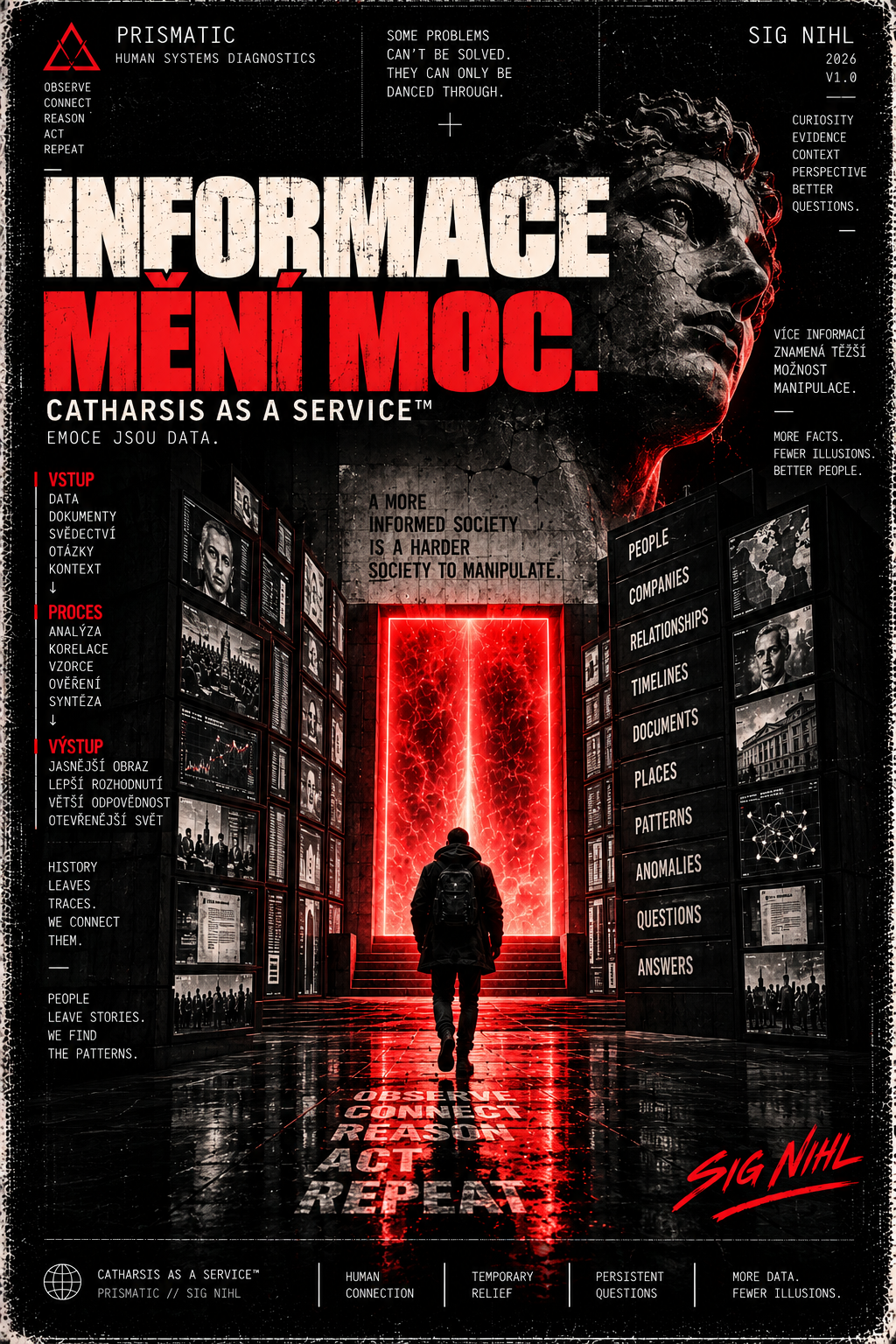
Catharsis as a Service™ is the first work in an open series of Sig Nihl / Prismatic artifacts: finished pieces that treat human states the way engineers treat systems. Observed, named, measured, and still not fixed.
What this is
A poster and a page. The poster sells a night of collective release. The page around it instruments that night: input, process, output, status. Both readings are true at once, and the piece only works if neither wins.
What this is not
Not an event, not a product and not a critique of people who dance. The telemetry is conceptual; nothing here measures anyone. There is no analytics, no tracker and no cookie.
Motivation
The project began with an observation about language. Relief is advertised in the vocabulary of services: on demand, repeatable, with a predictable response. A night out, a playlist, a scream room or a purchase is offered as the way to deal with what hurts. The relief is real. What troubled us is the silent promise that comes with it: that the feeling of release means the problem has been dealt with.
Psychology has studied exactly this gap for more than a century, from Breuer and Freud’s cathartic method to controlled experiments on venting and to meta-analyses of emotion regulation. Its findings rarely reach the places where release is sold. The artwork makes the gap visible; the library around it explains what is known, how strongly, and where knowledge stops.
The psychology behind it
The argument rests on a few well-studied ideas, each explained in its own note with references:
- Catharsis as a concept — its history from Aristotle to clinical practice: What is catharsis.
- Venting — why expressing anger through arousal tends to feed it: The venting hypothesis.
- Relief versus resolution — negative reinforcement and why relief can keep a problem in place: Relief is not resolution.
- Collective experience — synchrony, bonding and collective effervescence: Collective synchrony and Music and emotion regulation.
- Measurement — what signals can and cannot say about a state: Measuring emotion and the methods page.
Theory and background
Terms such as reappraisal, rumination, arousal or allostatic load are defined in the glossary. Every claim the site makes is recorded in the evidence ledger with its sources, its strength and the date it must be reviewed again. The advice library turns that evidence into graded, limited recommendations.
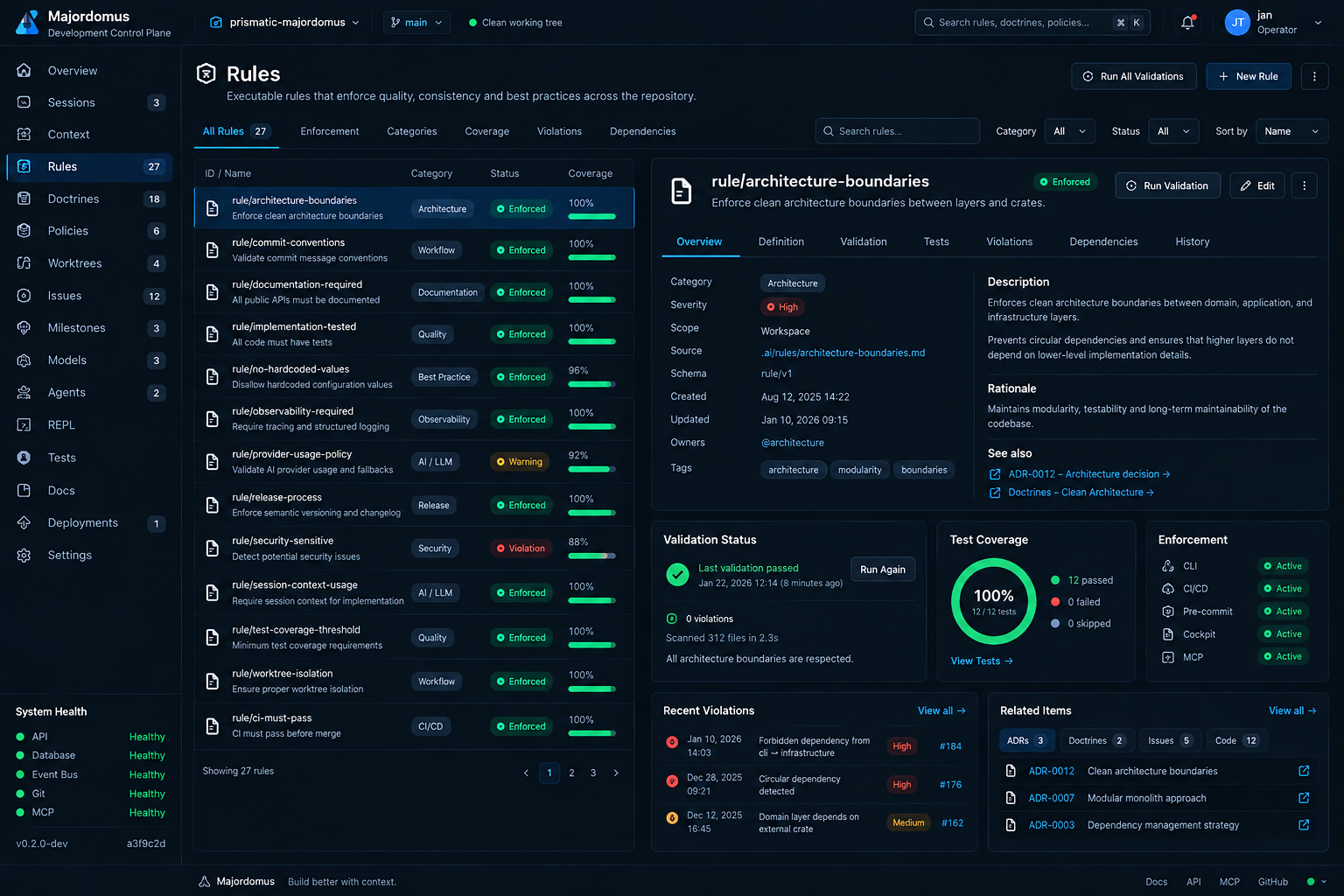
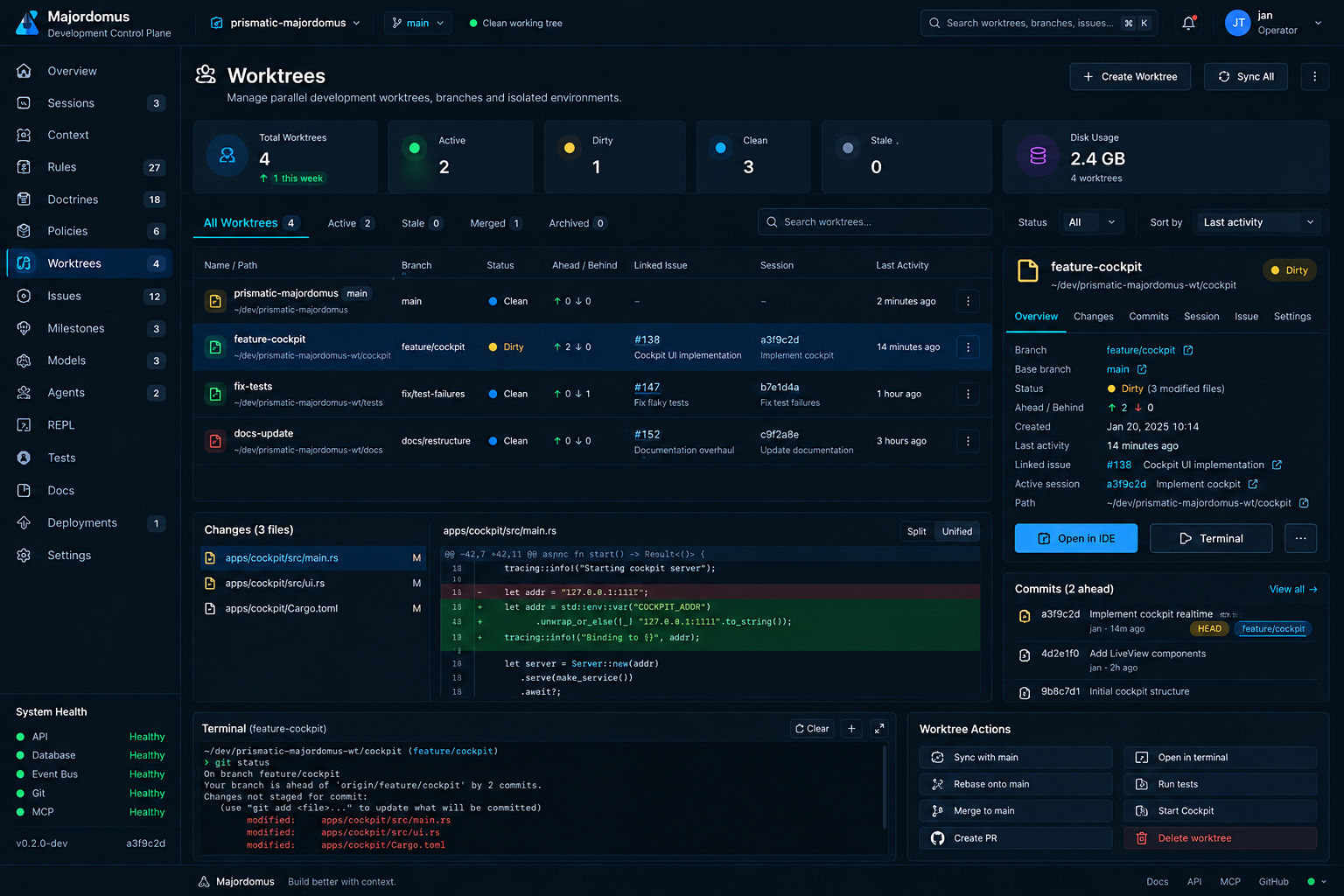
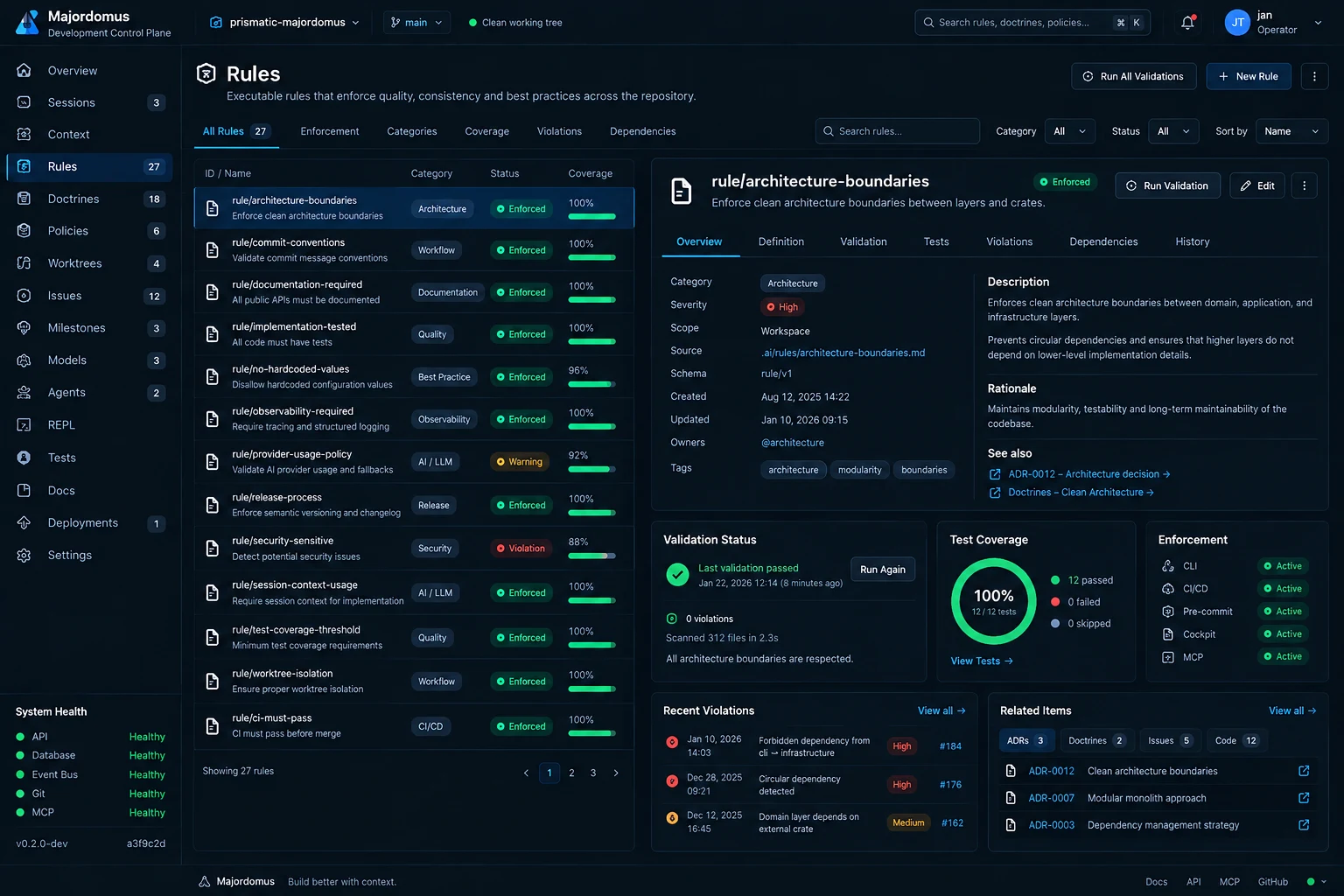
The concept screens below show the kind of supervision cockpit Majordomus is developing. They are illustrations with invented data; the records of how this site was actually built are in the method note.
Why a series
One poster is an opinion. A series is a method: the same diagnostic grammar (input, process, output, status) applied to different human rituals, so the differences between them become visible. The site is built so that the next artifact is a pair of Markdown files, not a redesign.
Principles
- The artwork leads. The interface exists to frame the poster, never to compete with it.
- Honest instruments. Anything that looks like data is labelled as conceptual, and the page itself collects nothing.
- Readable without scripts. JavaScript adds view modes, an artwork viewer and a copy button; the content is complete without it.
- Two languages, one structure. English and Czech are equal editions, checked for parity on every build.
- Claims need evidence. Nothing is called deployed until the live URL has been tested.
How it is built
Static HTML generated by Zola from Markdown, styled with Tailwind CSS, with Flowbite and Alpine.js for the few interactive parts. Every push to main is validated, deployed to GitHub Pages, verified in a real browser against the live URL, and released with a version derived from its commits. The guides explain each step and the reasoning behind it.
How the work was supervised
The site was built by an AI coding agent working under Majordomus, a supervisory layer between the agent and the repository. Majordomus did not write the site. It made the work accountable:
- Scoped tasks. Every change ran as a task with a declared scope. When files were moved outside that scope,
majordomus watchandmajordomus checkreported the drift before anything was pushed, and the task was restarted with a correct scope instead of being waved through. - Continuity. Checkpoints and handovers recorded what had changed and what came next, so the work could be resumed from recorded facts rather than from memory.
- A finish contract. A task can only be closed as completed when its verification command passes. Here that command is the smoke test against the live site, so “done” means “live and checked”.
- Wired enforcement. The
pre-commithook runsmajordomus doctor, thepre-pushhook runsmajordomus finish --check, and CI runs the same supervision check on every push and pull request. - Rules next to the code. Project rules (live verification before any claim, Zola as the source of truth, releases only from verified
main) live in.ai/repo/rules/, versioned with the code they govern.
The practical effect is fewer confident claims and more checked ones.
Rights
© 2026 Sig Nihl. All rights reserved; no open license is granted for the artwork or the text. The fonts (Anton, JetBrains Mono, Barlow Condensed) are distributed under the SIL Open Font License 1.1.
Artistic Poster series
-
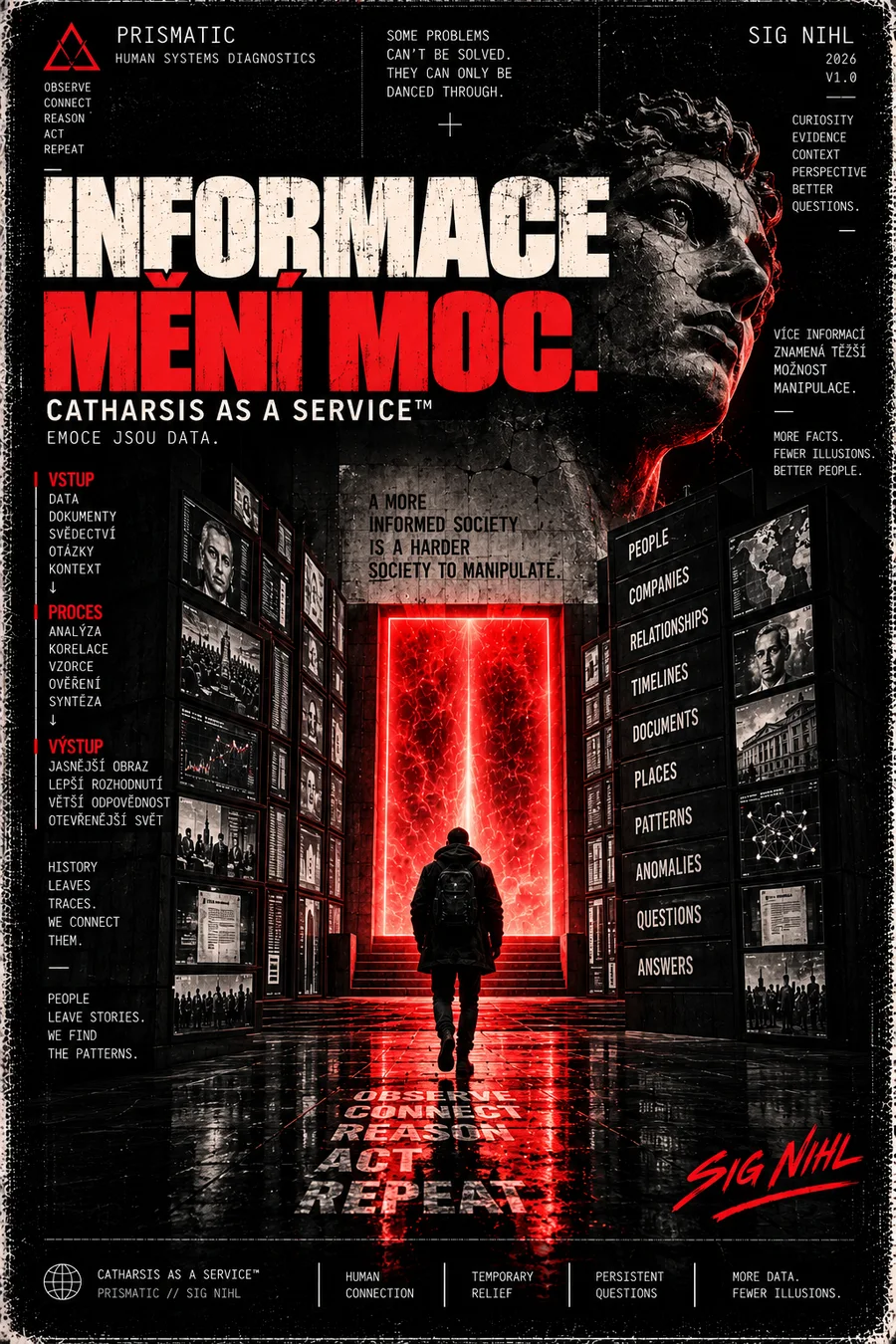
Information changes power A more informed society is a harder society to manipulate.
Concept screens · illustrative data
-
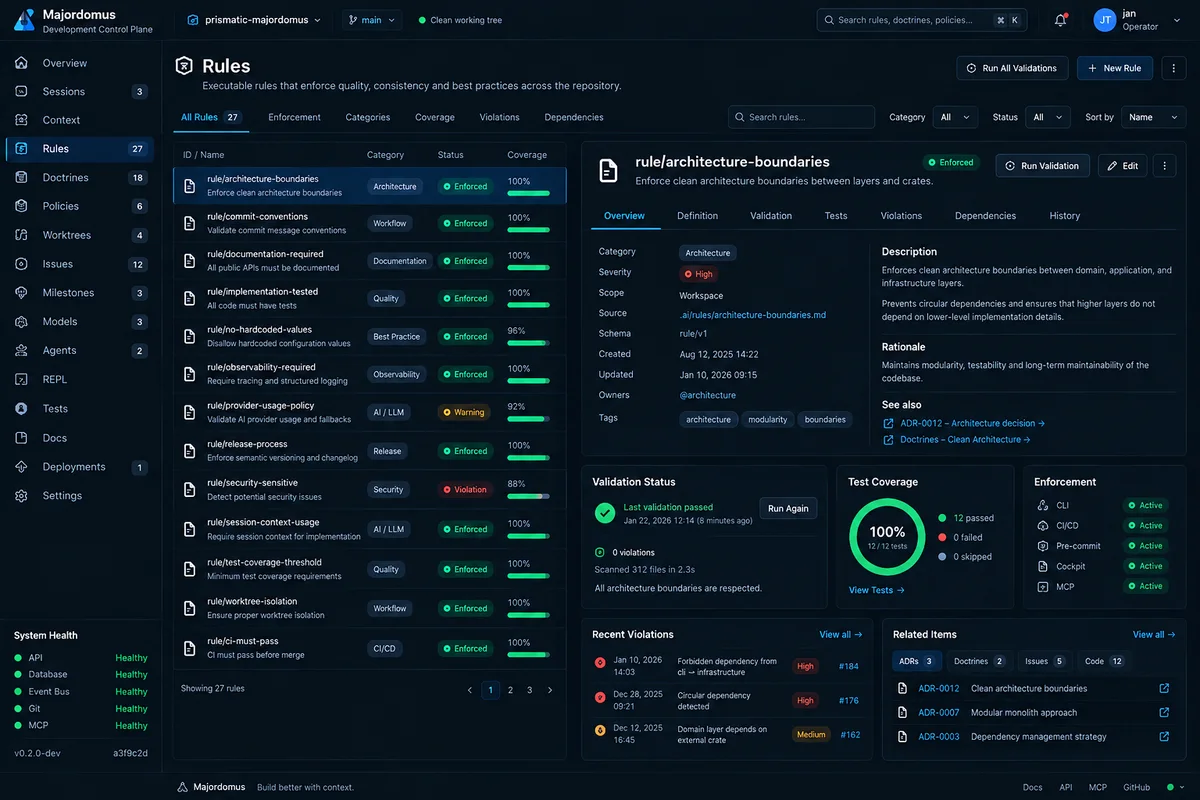
Rules Executable rules with their enforcement points: command line, CI, pre-commit hook.
-
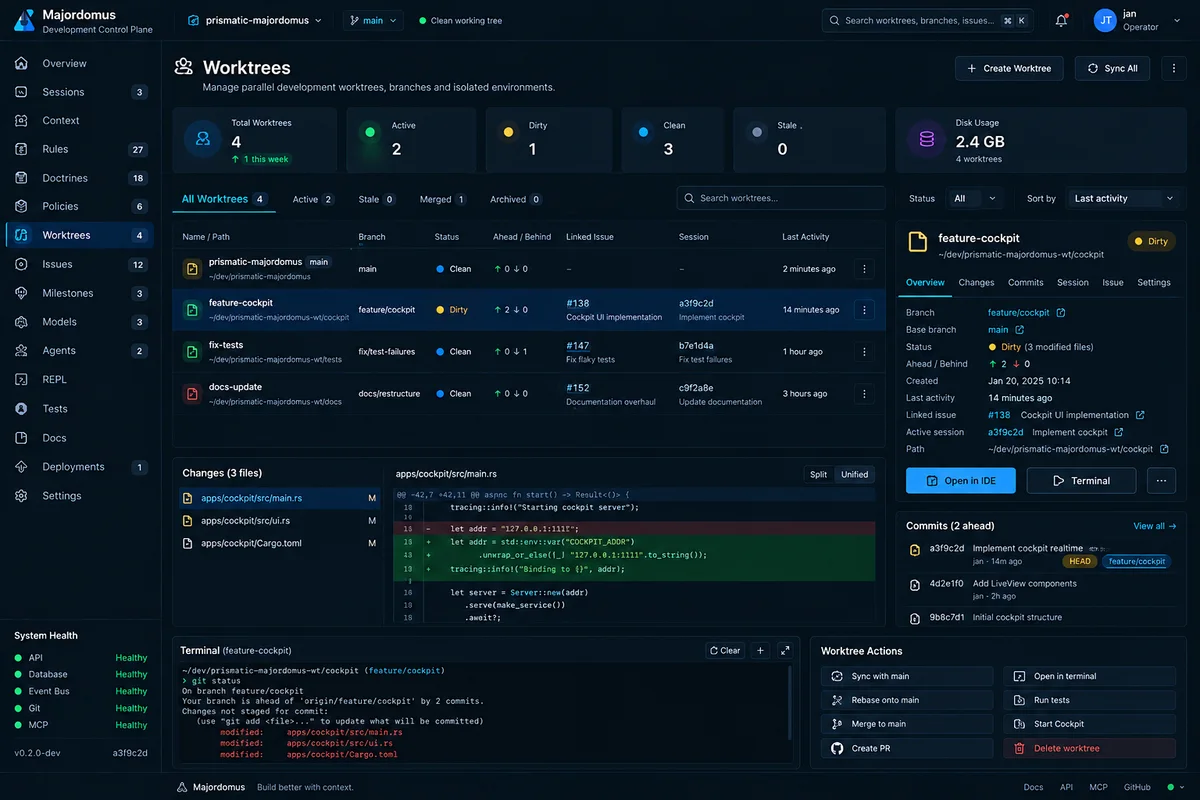
Worktrees Parallel branches in their own worktrees, each tied to an issue and a session.